

GHRP 2, Growth Hormone Inducing Peptides, Peptides
GHRP-2 Peptide: Mechanism, Growth Hormone Signaling, and Research Applications
Summarize the article with:
 ChatGPT
 Claude
 Perplexity
 Google AI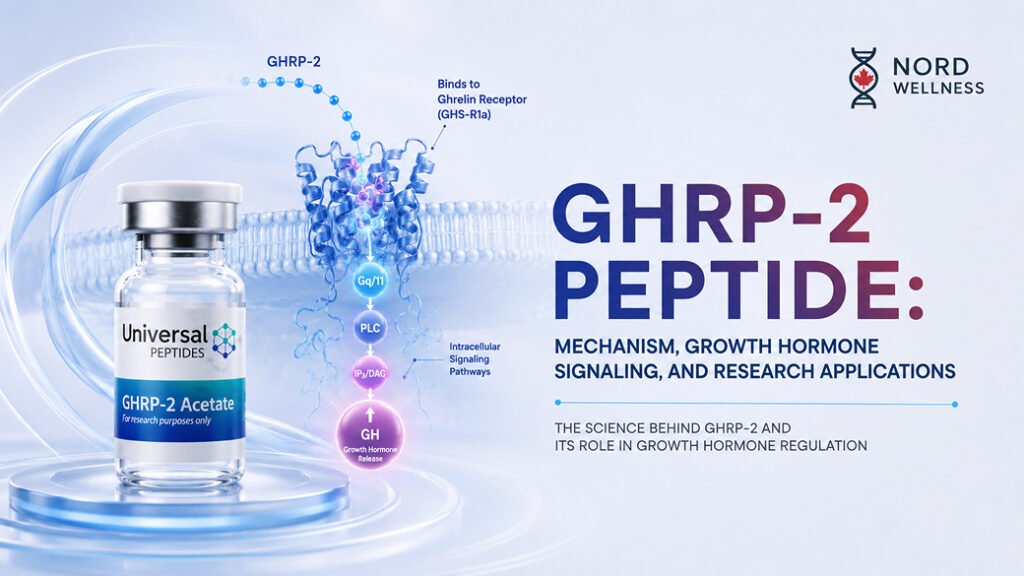
Jun
Growth hormone regulation is one of the most studied areas in endocrine research. Within this field, GHRP-2 peptide has drawn attention as a synthetic growth hormone secretagogue used to investigate ghrelin receptor activity, pituitary signaling, and downstream endocrine pathways.
For researchers looking to better understand peptide-based endocrine signaling, Nord Wellness provides research-focused peptide information and product resources designed for laboratory and educational use only.
What Is GHRP-2 Peptide?
GHRP-2, short for Growth Hormone-Releasing Peptide-2, is a synthetic peptide classified as a growth hormone secretagogue. In research contexts, it is studied for its ability to stimulate growth hormone release through pathways associated with the growth hormone secretagogue receptor, also known as the ghrelin receptor or GHS-R1a. GHRP-2 has been described in scientific literature as a synthetic agonist of ghrelin, the endogenous hormone that interacts with this receptor system.
Unlike growth hormone itself, GHRP-2 does not function as a replacement hormone. Instead, it is examined for how it may influence the body’s own regulatory mechanisms involved in growth hormone secretion. This makes it useful in laboratory models focused on endocrine feedback, pituitary function, and GH-axis signaling.
In peptide research, researchers often compare GHRP-2 with related compounds such as GHRP-6, hexarelin, and other growth hormone secretagogues. They typically study these peptides to understand how synthetic ligands interact with receptor systems that regulate growth hormone release, appetite signaling, metabolism, and broader neuroendocrine activity.
👉 Explore GHRP-2 Peptide for research purposes at GHRP-2 peptide
Structure and Classification of GHRP-2
GHRP-2 belongs to the broader class of growth hormone-releasing peptides, commonly abbreviated as GHRPs. These are synthetic peptides developed to stimulate growth hormone release in experimental and clinical research settings.
Structurally, GHRP-2 is commonly classified as a synthetic hexapeptide, meaning it consists of six amino acid residues. This compact structure allows it to interact with receptor systems involved in GH secretion. Like other GHRPs, it is part of the growth hormone secretagogue family, a category of compounds known for activating pathways that influence pituitary growth hormone release.
Its classification can be understood in several ways:
| Category | Description |
|---|---|
| Peptide type | Synthetic peptide |
| Functional class | Growth hormone secretagogue |
| Research category | Endocrine and pituitary signaling compound |
| Primary receptor target | GHS-R1a / ghrelin receptor |
| Main research focus | GH release, receptor activation, endocrine feedback |
Because GHRP-2 acts through ghrelin receptor-associated pathways, it is distinct from compounds that act directly on the growth hormone-releasing hormone receptor. This distinction is important for researchers studying how different regulatory mechanisms converge on growth hormone secretion.
Role of GHRP-2 in Ghrelin Receptor Activation
The central mechanism of GHRP-2 involves its interaction with the growth hormone secretagogue receptor type 1a (GHS-R1a), also known as the ghrelin receptor. GHS-R1a mediates the biological effects of ghrelin, including growth hormone release and other neuroendocrine responses.
Ghrelin is an endogenous peptide hormone produced mainly in the stomach and other tissues. It plays a role in energy balance, appetite-related signaling, and growth hormone regulation. GHRP-2 is studied because it can mimic certain ghrelin-like actions at the receptor level, making it a useful tool for examining how receptor activation influences GH secretion.
In simplified terms, the research model works like this:
- GHRP-2 binds to GHS-R1a
- Receptor activation triggers intracellular signaling
- Pituitary somatotroph cells respond
- Growth hormone release may increase under experimental conditions
- Downstream GH/IGF-1 axis activity can be evaluated
This does not mean GHRP-2 and ghrelin are identical. Ghrelin is a naturally occurring hormone with broad physiological roles, whereas GHRP-2 is a synthetic research peptide designed to activate secretagogue pathways. Their shared activity at the ghrelin receptor makes GHRP-2 valuable for studying receptor-mediated endocrine responses.
👉 Explore GHRP-2 Peptide for research purposes at GHRP-2 peptide
Growth Hormone Signaling and Endocrine Research
Researchers describe growth hormone secretion as regulated by a complex network involving the hypothalamus, pituitary gland, peripheral tissues, and feedback hormones. Two major hypothalamic regulators are:
- Growth hormone-releasing hormone, which promotes GH release
- Somatostatin, which inhibits GH release
GHRP-2 adds another layer to this system by activating ghrelin receptor-associated pathways. Research suggests that growth hormone secretagogues may act at both hypothalamic and pituitary levels, influencing GH release through mechanisms that are not identical to GHRH alone. Studies have investigated whether GHRP-2 can directly stimulate pituitary somatotroph cells, supporting its relevance in GH-release research models.
Once GH is released, it can influence downstream endocrine pathways, especially the GH/IGF-1 axis. Growth hormone can stimulate the liver and other tissues to produce insulin-like growth factor 1, commonly known as IGF-1. In research, this axis is important for studying tissue growth, metabolism, protein turnover, and endocrine feedback.
GHRP-2 research may therefore involve several connected areas:
- Pituitary GH secretion
- Ghrelin receptor signaling
- GH pulse dynamics
- IGF-1 pathway response
- Somatostatin and GHRH interaction
- Neuroendocrine feedback loops
- Metabolic signaling models
Because endocrine systems are highly interconnected, researchers often study GHRP-2 not only as a GH secretagogue but also as a tool for understanding receptor-specific regulation within the broader hormonal network.
Common Research Applications of GHRP-2
GHRP-2 is primarily used in laboratory and scientific contexts related to endocrine function. Its research applications usually focus on mechanism, signaling, and biological response rather than direct therapeutic claims.
1. Growth Hormone Secretion Studies
The most common research application of GHRP-2 involves examining how growth hormone release is regulated. Researchers may use GHRP-2 to study GH pulse patterns, pituitary responsiveness, or secretagogue receptor activation.
2. Ghrelin Receptor Research
Because GHRP-2 interacts with GHS-R1a, it is useful in research focused on ghrelin receptor biology. This includes studying receptor binding, intracellular signaling, receptor distribution, and how ghrelin-like compounds affect endocrine function.
3. Pituitary and Hypothalamic Signaling
Researchers use GHRP-2 in models that examine communication between the hypothalamus and pituitary gland. These studies help them better understand how multiple signals simultaneously regulate growth hormone secretion.
4. GH/IGF-1 Axis Investigation
Since GH can influence IGF-1 production, GHRP-2 may be studied in relation to downstream endocrine responses. This makes it relevant for experiments involving hormone cascades, feedback regulation, and metabolic signaling.
5. Comparative Peptide Research
Researchers often compare GHRP-2 with other peptides, including GHRP-6, hexarelin, ipamorelin, and GHRH analogues. These comparisons help clarify differences in receptor selectivity, potency, signaling behavior, and endocrine response patterns.
6. Metabolism and Energy Balance Models
Because ghrelin receptor systems also relate to appetite and energy regulation, researchers have explored GHRP-2 in studies on food intake, metabolic signaling, and neuroendocrine control. Scientific literature notes that ghrelin and GHRP-2 share relevance in growth hormone secretion and appetite-related research, although researchers interpret these effects only within controlled study settings.
Storage, Stability, and Research Considerations
Proper storage and handling are essential when working with research peptides. Peptides can be sensitive to temperature, light, moisture, pH, and repeated freeze-thaw cycles. Poor handling may affect stability and compromise research consistency.
For many lyophilized peptides, researchers commonly recommend long-term storage at low temperatures, often around −20°C, away from light and moisture. Lyophilized peptides are generally more stable than reconstituted peptides. Once reconstituted, peptides become more vulnerable to degradation and require stricter, controlled storage conditions.
Key research handling considerations include:
- Store lyophilized peptide vials sealed and dry.
- Avoid unnecessary exposure to room temperature.
- Protect from direct light where possible.
- Use sterile, controlled laboratory techniques during reconstitution.
- Avoid repeated freeze-thaw cycles.
- Follow supplier-specific documentation, including certificate of analysis and storage guidance.
- Keep accurate records of lot number, concentration, solvent, and storage conditions.
Stability can vary depending on peptide sequence, formulation, solvent, concentration, pH, and storage duration. For this reason, researchers should always follow validated lab protocols and supplier documentation rather than relying on general guidance alone.
Why GHRP-2 Matters in Peptide Research
GHRP-2 remains relevant because it gives researchers a way to study the relationship between synthetic secretagogues, ghrelin receptor activation, and growth hormone signaling. Its value lies not in oversimplified claims, but in its ability to help clarify how endocrine systems respond to receptor-level stimulation.
In particular, GHRP-2 supports research into:
- How GHS-R1a activation influences GH release
- How GH secretion interacts with hypothalamic and pituitary regulation
- How secretagogue peptides differ from GHRH-based compounds
- How GH/IGF-1 signaling behaves under controlled experimental conditions
- How ghrelin-like receptor activity connects endocrine and metabolic pathways
For researchers exploring peptide-based endocrine models, GHRP-2 provides a focused compound for studying hormone signaling, receptor pharmacology, and biological feedback systems.
👉 SEE MORE:
- GHRP-2 Mechanism: Ghrelin Receptor Activation and Signaling Pathways
- How GHRP-2 Works: Ghrelin Receptor and Hormone Signaling Explained
FAQ: GHRP-2 Peptide
What is GHRP-2 peptide?
GHRP-2 is a synthetic growth hormone-releasing peptide classified as a growth hormone secretagogue. It is studied for its interaction with the ghrelin receptor, also known as GHS-R1a, and its role in growth hormone signaling research.
How does GHRP-2 work?
GHRP-2 is studied for its ability to activate the growth hormone secretagogue receptor. This receptor activity may stimulate pituitary signaling involved in growth hormone release under controlled research conditions.
Is GHRP-2 the same as growth hormone?
No. GHRP-2 is not growth hormone. It is a synthetic peptide studied for its ability to influence pathways that regulate endogenous growth hormone release.
What receptor does GHRP-2 target?
GHRP-2 primarily interacts with the growth hormone secretagogue receptor type 1a (GHS-R1a), also known as the ghrelin receptor.
What is GHRP-2 used for in research?
Researchers commonly use GHRP-2 in studies of growth hormone secretion, ghrelin receptor activation, pituitary signaling, the GH/IGF-1 axis, and comparative peptide research.
Is GHRP-2 a supplement?
No. GHRP-2 should not be described as a supplement. It is a research peptide intended only for laboratory and educational research contexts.
How should GHRP-2 be stored?
Storage requirements depend on supplier specifications and formulation. In general, researchers store lyophilized peptides sealed, dry, protected from light, and at low temperatures (e.g., −20°C) for long-term stability. Reconstituted peptides typically require stricter handling and shorter storage windows.
What makes GHRP-2 different from GHRP-6?
Both are growth hormone-releasing peptides, but they may differ in receptor activity, research response patterns, and biological signaling profiles. GHRP-2 is often studied alongside GHRP-6 to compare how different secretagogues influence GH release and related endocrine pathways.
Does GHRP-2 affect appetite?
GHRP-2 is associated with ghrelin receptor pathways, and ghrelin biology is linked to appetite and energy balance. However, appetite-related findings should be interpreted carefully and only within the context of controlled research.
Is GHRP-2 approved for medical use?
This article discusses GHRP-2 strictly as a research peptide. It is not presented as an approved medication, therapeutic product, or treatment. Researchers should follow all applicable laws, regulations, and institutional guidelines.
Final Thoughts
GHRP-2 Peptide is an important research compound for studying growth hormone signaling, ghrelin receptor activation, and endocrine feedback mechanisms. By interacting with the GHS-R1a receptor, GHRP-2 helps researchers examine how synthetic growth hormone secretagogues influence pituitary activity and downstream pathways such as the GH/IGF-1 axis.
Its value lies in its ability to support deeper investigation into hormone regulation, receptor-specific signaling, and the relationship between neuroendocrine and metabolic systems. However, like all research peptides, GHRP-2 requires careful interpretation, proper laboratory handling, and responsible use within controlled research settings.
Disclaimer
This content is provided by Nord Wellness for educational and research purposes only. GHRP-2 Peptide is not approved for the diagnosis, treatment, cure, or prevention of any disease.



This was a very informative overview of GHRP-2 and its role in growth hormone signaling research. I appreciated how the article explained receptor interactions and peptide activity in a way that was detailed without being overly technical. The section discussing endocrine signaling pathways added valuable context for understanding why GHRP-2 remains relevant in peptide research.
Great article overall. Many discussions about growth hormone peptides focus mainly on outcomes, but this piece did a great job explaining the biological mechanisms behind GHRP-2. I’d be interested in seeing a future article comparing GHRP-2 with GHRP-6 and Ipamorelin from a signaling and receptor-activity perspective.
Really enjoyed reading this article. The explanation of peptide signaling, receptor activation, and growth hormone-related pathways was clear and easy to follow. It’s refreshing to find research-focused content that provides scientific depth while remaining accessible to readers who are still learning about peptide science.
Pingback: How GHRP-2 Works: Ghrelin Receptor and Hormone Signaling Explained - nordwellness.ca