

GHRP 2, Growth Hormone Inducing Peptides, Peptides
How GHRP-2 Works: Ghrelin Receptor and Hormone Signaling Explained
Summarize the article with:
 ChatGPT
 Claude
 Perplexity
 Google AI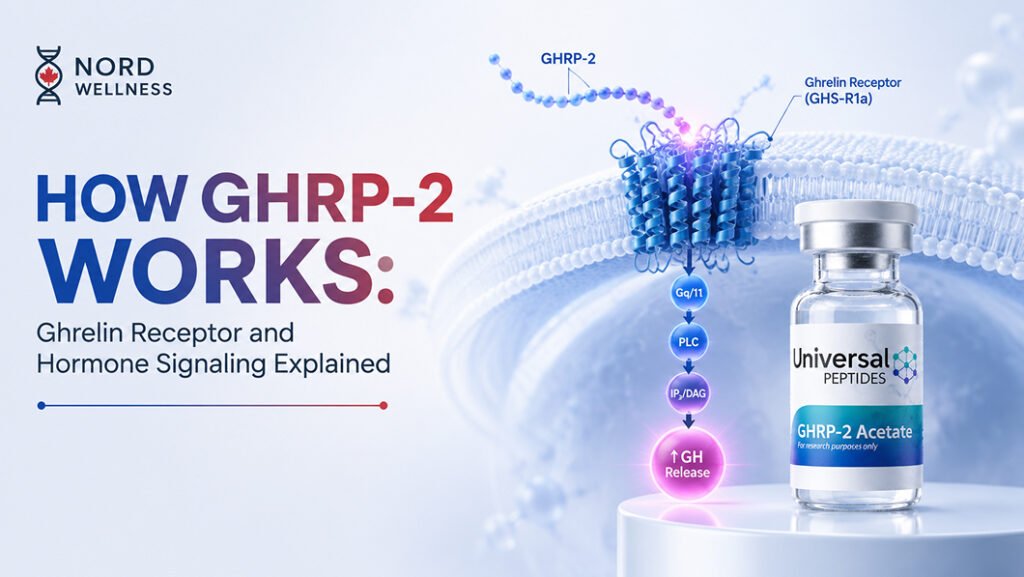
Jun
Growth hormone regulation is a complex process controlled by multiple signaling pathways. GHRP-2 (Growth Hormone-Releasing Peptide-2) is a synthetic peptide studied extensively in research for its effects on ghrelin receptor activation, pituitary signaling, and downstream endocrine pathways.
At Nord Wellness, we provide detailed research-focused peptide resources designed for laboratory and educational use only. This article explains how GHRP-2 works, its receptor interactions, and its applications in experimental models.
How Does GHRP-2 Work in the Body?
GHRP-2 is a synthetic growth hormone secretagogue, meaning researchers study it for its ability to stimulate growth hormone (GH) release under controlled conditions. Unlike growth hormone itself, GHRP-2 does not replace or act as GH; rather, it activates receptor-mediated pathways that influence the body’s endogenous GH secretion.
The simplified mechanism involves:
- Binding to the ghrelin receptor (GHS-R1a).
- Triggering intracellular signaling cascades in pituitary somatotroph cells.
- Stimulating growth hormone release in experimental models.
- Engaging downstream GH/IGF-1 axis signaling, influencing metabolic and endocrine feedback pathways.
This mechanism allows researchers to explore receptor-specific endocrine signaling without directly introducing exogenous GH. As a result, it provides a controlled model for studying growth hormone regulation and related metabolic pathways.
👉 Explore GHRP-2 Peptide for research purposes at GHRP-2 peptide

GHRP-2 and Ghrelin Receptor Activation Explained
The GHS-R1a receptor, also known as the ghrelin receptor, is the primary target of GHRP-2. Ghrelin is an endogenous peptide hormone involved in GH regulation, appetite, and energy balance. GHRP-2 mimics ghrelin-like activity at this receptor, making it a valuable research tool.
Key points about receptor interaction:
- GHRP-2 acts as a synthetic agonist of GHS-R1a.
- Activation of the receptor triggers intracellular signaling cascades including second messengers and calcium mobilization.
- This receptor is expressed in the pituitary and hypothalamus, critical areas for GH regulation.
By studying GHRP-2, researchers can observe how ghrelin receptor activation contributes to growth hormone release, receptor pharmacology, and broader endocrine effects. Consequently, it serves as a valuable tool for understanding GH-related signaling and metabolic regulation.
Effects on Growth Hormone Signaling
Researchers describe growth hormone secretion as primarily regulated by GHRH (Growth Hormone-Releasing Hormone) and somatostatin. In addition, GHRP-2 adds an additional regulatory input via the ghrelin receptor pathway.
- Pituitary somatotroph activation: GHRP-2 binding to GHS-R1a triggers somatotroph cells to release GH.
- Downstream GH/IGF-1 signaling: GH stimulates production of IGF-1 in peripheral tissues, which participates in feedback and metabolic regulation.
- Pulse dynamics: GHRP-2 helps researchers study GH pulse frequency and amplitude in experimental settings.
This makes GHRP-2 particularly useful in studies examining endocrine regulation and GH-axis behavior.
👉 Explore GHRP-2 Peptide for research purposes at GHRP-2 peptide
GHRP-2 and Endocrine System Interaction
GHRP-2 interacts with complex endocrine feedback networks, including:
- Hypothalamic regulation (GHRH and somatostatin)
- Pituitary GH secretion
- Peripheral IGF-1 production
- Appetite and energy balance signaling
Because GH signaling interconnects with multiple hormonal pathways, researchers can use GHRP-2 to study how receptor activation integrates into systemic endocrine responses.

Role in Experimental Metabolic Models
Researchers often include GHRP-2 in experimental metabolic and endocrine models to investigate several key processes, including:
- Investigating GH-dependent metabolism
- Studying ghrelin receptor-mediated appetite signaling
- Examining energy balance and neuroendocrine regulation
In research settings, GHRP-2 allows scientists to test how synthetic secretagogues influence both hormone release and downstream metabolic pathways in a controlled environment.
What Makes GHRP-2 Unique Among Peptides?
GHRP-2 is distinct compared to other peptides like GHRP-6, hexarelin, or GHRH analogs because:
- It is a synthetic ghrelin receptor agonist, specifically targeting GHS-R1a.
- It acts indirectly via receptor-mediated pathways, rather than directly introducing GH.
- It allows detailed study of pituitary, hypothalamic, and downstream endocrine mechanisms.
- Its synthetic nature provides reproducibility and consistency in research models.
These characteristics make GHRP-2 a versatile tool for researchers studying growth hormone regulation, receptor pharmacology, and endocrine feedback mechanisms. In other words, it provides a controlled model for investigating complex endocrine pathways.
For a broader overview, read our complete guide: GHRP-2 Peptide: Mechanism, Growth Hormone Signaling, and Research Applications.
FAQ – How GHRP 2 Works
How does GHRP-2 work?
GHRP-2 binds to the ghrelin receptor (GHS-R1a), activating intracellular pathways that stimulate GH release in experimental research.
Is GHRP-2 the same as GH?
No. GHRP-2 is a synthetic secretagogue that promotes endogenous GH release; it is not a hormone replacement.
What receptor does GHRP-2 target?
The primary receptor is GHS-R1a, the ghrelin receptor located in the hypothalamus and pituitary.
How does it affect the endocrine system?
GHRP-2 influences GH secretion, IGF-1 production, and neuroendocrine feedback, thereby integrating into broader hormone regulation networks.
Why is it used in metabolic studies?
Because ghrelin receptor activation affects GH and appetite signaling, GHRP-2 is studied in energy balance and endocrine regulation models.
Is GHRP-2 a supplement?
No. Instead, it is strictly a research peptide intended for laboratory and educational use.
How is GHRP-2 stored for research?
By studying GHRP-2, researchers can observe how ghrelin receptor activation contributes to growth hormone release, receptor pharmacology, and broader endocrine effects. In this way, it serves as a valuable tool for understanding GH-related signaling and metabolic regulation.
Final Thoughts
GHRP-2 works by activating the ghrelin receptor, triggering signaling pathways that influence growth hormone secretion and downstream endocrine responses. Its utility in research lies in providing a controlled method to study pituitary function, GH/IGF-1 axis activity, and metabolic signaling.
Used responsibly in laboratory settings, GHRP-2 contributes to a deeper understanding of hormone regulation, receptor biology, and synthetic peptide mechanisms.
For researchers seeking high-quality peptide information and resources, explore more at Nord Wellness for research-grade peptides and educational content.
Disclaimer
This content is provided by Nord Wellness for educational and research purposes only. GHRP-2 Peptide is not approved for the diagnosis, treatment, cure, or prevention of any disease.



Excellent article explaining how GHRP-2 functions within the body’s growth hormone pathway. I appreciated how the information was presented in a straightforward way without being overly technical. Have you seen any research discussing how individual response to GHRP-2 may vary based on age or training experience?
Thanks for putting together such a detailed explanation of how GHRP-2 works. Many articles focus on benefits, but understanding the underlying mechanism provides much better context. I’d be interested to know how GHRP-2 compares mechanistically with some of the newer growth hormone secretagogues.
This was a helpful and well-structured read. The explanation of how GHRP-2 stimulates growth hormone release made the topic much easier to follow than some of the scientific papers I’ve read. Do yo