

Aesthetics & Libido, Peptides, PT-141
PT-141 Peptide Mechanism of Action: How It Works and Why Researchers Study It
Summarize the article with:
 ChatGPT
 Claude
 Perplexity
 Google AI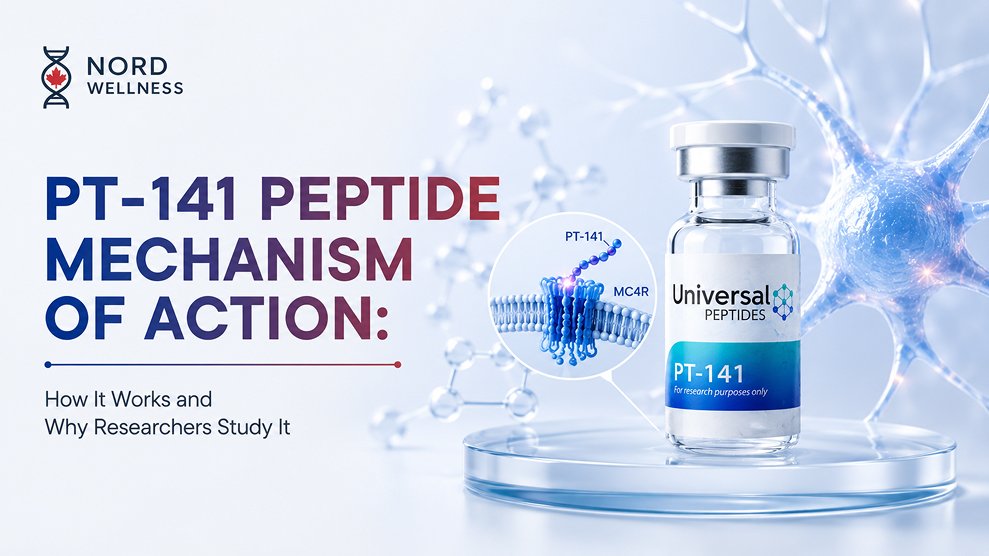
Jun
PT-141, also known as Bremelanotide, is a synthetic research peptide that has garnered significant attention in the fields of sexual health and neuroendocrine research. Unlike peripheral agents that act on blood flow, PT-141 works centrally in the brain, influencing sexual desire, motivation, and related behaviors.
This article provides a comprehensive look at PT-141’s mechanism of action, the receptor pathways it engages, how it differs from other peptides, and the main research areas in which it is studied.
For further detailed insights and related peptide research, visit Nord Wellness
What Is PT-141 Peptide?
PT-141 is a 7-amino acid cyclic peptide derived from melanocortin receptor agonists. Originally developed to explore central nervous system pathways, it has become a focal point in research due to its unique ability to modulate sexual behavior and neuroendocrine function.
Key characteristics include:
- Central action: Targets the hypothalamus and limbic system, rather than peripheral blood vessels.
- Selective receptor binding: Primarily interacts with MC4R, with additional activity at MC1R and MC3R.
- Research utility: Serves as a probe to study melanocortin receptor signaling, motivation, and behavioral neuroscience.
👉 Explore PT-141 Peptide for research purposes at PT-141 Peptide
Understanding the PT-141 Mechanism of Action
PT-141’s mechanism is primarily central, distinguishing it from most sexual health compounds:
- Activation of melanocortin receptors: PT-141 binds selectively to MC4R receptors in the hypothalamus.
- Neurotransmitter modulation: Receptor activation influences dopamine, nitric oxide, and serotonin pathways, which are critical for sexual desire and arousal.
- Behavioral effects: By modulating these pathways, PT-141 can increase sexual motivation, arousal, and receptivity in research models.
- Non-hormonal action: PT-141 does not replace endocrine hormones, providing a non-hormonal approach to studying sexual behavior.
This central mechanism allows researchers to investigate sexual function from a neuroendocrine and behavioral perspective, beyond simple vascular responses.
Receptor Pathways Involved in PT-141 Activity
PT-141 engages multiple melanocortin receptor subtypes (MCRs), which each contribute differently:
- MC1R: Primarily involved in pigmentation; minor contribution to sexual function.
- MC3R: Influences energy balance and reward pathways; may indirectly affect sexual motivation.
- MC4R: Key receptor for sexual desire; central target for PT-141’s effects.
Understanding these receptor interactions is critical for interpreting experimental outcomes and for designing protocols that explore sexual behavior, motivation, and neuroendocrine signaling.
👉 Explore PT-141 Peptide for research purposes at PT-141 Peptide
PT-141 Compared With Other Peptides
PT-141 differs from other peptides commonly studied in sexual health and CNS research:
- Vs. Vasodilatory agents (e.g., sildenafil): PT-141 acts centrally, while sildenafil acts peripherally on blood flow.
- Vs. Hormonal peptides: Unlike testosterone or estrogen analogs, PT-141 does not replace or mimic endocrine hormones.
- Vs. other melanocortin peptides: PT-141 is highly selective for MC4R, making its behavioral effects more focused and reproducible in research settings.
These differences highlight PT-141’s unique value as a research tool for neurobehavioral studies.
Research Areas Involving PT-141
PT-141 is being explored in multiple research contexts:
- Sexual health studies: Hypoactive sexual desire disorder (HSDD), female sexual arousal, and libido enhancement.
- Neuroendocrine research: Study of melanocortin receptor signaling and its effects on dopamine and nitric oxide pathways.
- Behavioral neuroscience: Investigating the link between central receptor activation, motivation, and reward pathways.
- Potential mood and stress studies: Early research suggests PT-141 may influence stress response and anxiety modulation via central pathways.
These applications are still under controlled research conditions and provide valuable insights into CNS function and behavioral regulation.
PT-141 continues to be a valuable peptide for CNS and sexual behavior research. Its central mechanism and selective receptor activity provide unique opportunities for neuroendocrine, behavioral, and sexual health studies.
For a detailed exploration of PT-141’s benefits, dosage protocols, and research applications, visit PT-141 Peptide Benefits: Mechanism, Research Findings, and Potential Applications
FAQ About PT-141 Peptide Mechanism of Action
How does PT-141 work centrally?
PT-141 binds to MC4R receptors in the hypothalamus, modulating dopamine, nitric oxide, and serotonin pathways, which collectively enhance sexual desire and arousal.
Is PT-141 similar to Viagra or other ED drugs?
No. PT-141 acts centrally on the brain, whereas ED drugs like Viagra act peripherally on blood flow.
Can PT-141 be used outside research?
No. PT-141 is a research peptide and should not be used outside approved laboratory or clinical studies.
What factors influence PT-141’s effects?
Sex differences, baseline hormonal status, dose, and administration method can all impact PT-141 outcomes in research studies.
What are the key research benefits of PT-141?
Studies show increased sexual motivation, arousal, and satisfaction, as well as potential modulation of mood and stress responses in controlled research settings.
Final Thoughts
PT-141 stands out in research for its unique central mechanism, acting directly on MC4R melanocortin receptors in the hypothalamus to influence sexual motivation, arousal, and neuroendocrine pathways. Unlike peripheral agents or hormonal therapies, its effects are non-vascular and non-hormonal, making it a valuable tool for studying behavioral neuroscience and sexual health.
Researchers exploring PT-141 must carefully consider dosage, administration method, sex differences, and baseline hormonal status to ensure reproducible and meaningful results. Ethical oversight, precise documentation, and adherence to study protocols are essential when working with this peptide.
Disclaimer
This content is provided by Nord Wellness for educational and research purposes only. PT-141 Peptide is not approved for the diagnosis, treatment, cure, or prevention of any disease.


This article did an excellent job explaining the mechanism of action behind PT-141 in a way that was both detailed and easy to follow. I especially appreciated the breakdown of melanocortin receptor signaling and how it differs from more traditional approaches. The focus on the underlying biology made the content feel much more informative and credible.
Great article overall. Many resources mention PT-141 but don’t go into much detail about the receptor pathways and cellular signaling involved. This article provided a clear explanation of the science while keeping the information accessible for readers who are still learning about peptide research.
Really enjoyed reading this article. The discussion around receptor activation, neuroendocrine signaling, and downstream biological responses added much more depth than most PT-141 content available online. I’d be interested in seeing more articles that compare the mechanisms of different melanocortin-related peptides.