

Healing & Regeneration, KPV, Peptides
KPV Mechanism Explained: Cytokine Modulation and Cellular Signaling
Summarize the article with:
 ChatGPT
 Claude
 Perplexity
 Google AI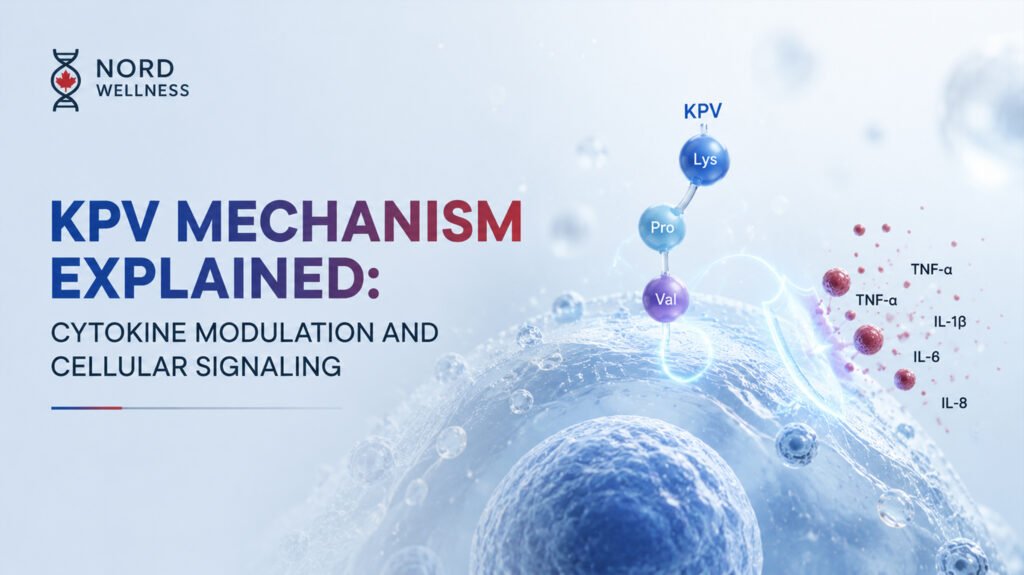
May
In peptide research, KPV mechanism is often discussed in relation to inflammatory signaling, cytokine expression, epithelial barrier function, and immune-cell communication. KPV consists of three amino acids—lysine, proline, and valine—and researchers identify it as the C-terminal fragment of alpha-melanocyte-stimulating hormone (α-MSH). Research literature has described KPV as one of the small α-MSH-related peptide fragments associated with anti-inflammatory activity, although researchers still investigate its exact signaling mechanism.
For researchers looking to better understand peptide mechanisms, inflammatory pathways, and research-use compounds, Nord Wellness provides science-focused peptide education with responsible research context.
What Is the Mechanism of KPV?
The mechanism of KPV refers to how this tripeptide may influence biological signaling systems under experimental conditions. Unlike larger peptide hormones that may depend on broad receptor networks, KPV is structurally minimal, which makes it useful for studying how a short amino acid sequence can influence cellular responses.
KPV is most commonly studied in relation to:
| Mechanism Area | Research Relevance |
|---|---|
| Cytokine modulation | Helps evaluate inflammatory mediator expression |
| NF-κB signaling | Relevant to inflammatory gene transcription |
| Epithelial cell response | Important in barrier-function models |
| Immune-cell signaling | Used in macrophage, T-cell, and inflammation models |
| Oxidative stress markers | Studied in relation to inflammatory damage |
| Peptide transport | Especially relevant to intestinal epithelial research |
The core idea behind KPV research is that a small α-MSH-derived fragment may retain part of the parent peptide’s inflammation-modulating behavior. However, KPV should not be described as a proven treatment. A more accurate statement is that KPV is a research peptide studied for its role in inflammatory signaling and cellular pathway modulation.
KPV Interaction with Cellular Signaling Pathways
KPV has been studied across different cell systems, including intestinal epithelial cells, immune cells, and bronchial epithelial cells. One of the most important areas of interest is how KPV may interact with intracellular signaling pathways that regulate inflammation.
A major pathway discussed in KPV research is NF-κB signaling. NF-κB is a transcription factor involved in the expression of many inflammatory genes. When activated, NF-κB can increase the production of inflammatory mediators such as TNF-α, IL-1β, IL-6, and other cytokines.
Research on KPV in bronchial epithelial cells has suggested that KPV can suppress inflammatory signaling, with one study discussing a possible role for melanocortin-3 receptor-related mechanisms in local anti-inflammatory activity.
Key Cellular Pathways Associated with KPV Research
| Pathway or Target | Why It Matters |
|---|---|
| NF-κB | Controls many inflammatory gene-expression patterns |
| Cytokine signaling | Helps regulate immune-cell communication |
| Epithelial signaling | Important in mucosal and barrier research |
| Melanocortin-related pathways | Connected to α-MSH-derived peptide biology |
| Peptide transporter pathways | Relevant to cellular uptake, especially in gut models |
One important point is that KPV research is not limited to one single mechanism. Instead, studies suggest that KPV may influence inflammation through multiple overlapping systems, including peptide uptake, cytokine regulation, epithelial response, and intracellular signaling.
Modulation of Cytokine Expression
Cytokine modulation is one of the most important parts of the KPV mechanism. Cytokines are signaling proteins that help immune cells and tissue cells communicate. In inflammatory models, excessive cytokine production is often used as a marker of cellular stress or immune activation.
KPV has been studied for its ability to affect the expression of pro-inflammatory cytokines. In experimental settings, researchers often evaluate whether KPV changes the levels or activity of cytokines such as:
| Cytokine | Research Importance |
|---|---|
| TNF-α | Major inflammatory cytokine involved in immune activation |
| IL-1β | Linked to inflammatory cascade signaling |
| IL-6 | Associated with acute and chronic inflammatory response |
| IL-8 | Involved in neutrophil recruitment and epithelial inflammation |
Research comparing α-MSH fragments has shown that KPV demonstrates anti-inflammatory activity, supporting the idea that the C-terminal region of α-MSH may contribute meaningfully to inflammation-related signaling effects.
How KPV May Influence Cytokine Expression
In research models, KPV may influence cytokine expression by affecting upstream signaling systems that regulate inflammatory gene transcription. As a result, researchers frequently discuss NF-κB in relation to KPV. If KPV reduces or modulates NF-κB activity, downstream cytokine expression may also change.
A simplified research model may look like this:
| Step | Research Interpretation |
|---|---|
| Inflammatory stimulus occurs | Cells activate inflammatory signaling pathways |
| NF-κB and related pathways become active | Pro-inflammatory genes may be expressed |
| Cytokines increase | TNF-α, IL-1β, IL-6, or IL-8 may rise |
| KPV is introduced in the model | Researchers observe whether signaling changes |
| Cytokine output is measured | Results help define KPV’s mechanism |
This makes KPV especially useful in mechanistic studies because researchers can examine both upstream signaling and downstream cytokine outcomes.
KPV and Oxidative Stress Markers
Inflammation and oxidative stress are closely connected. When inflammatory stimuli affect cells, the cells may produce reactive oxygen species, commonly referred to as ROS. These molecules can contribute to cellular stress, tissue damage, and changes in signaling behavior.
Although researchers primarily study KPV in inflammation-related research, they also consider oxidative stress markers relevant because inflammatory signaling often overlaps with oxidative pathways. In many experimental models, researchers measure oxidative stress alongside cytokines to better understand the overall cellular response.
Oxidative Stress Markers Commonly Studied in Inflammation Models
| Marker | Research Meaning |
|---|---|
| ROS | Indicates reactive oxygen species activity |
| MDA | Marker associated with lipid peroxidation |
| SOD | Antioxidant enzyme activity marker |
| GSH | Glutathione-related antioxidant capacity |
| Nitric oxide-related markers | Often linked to inflammatory signaling |
Researchers should discuss KPV’s relationship with oxidative stress carefully. It is more accurate to say that researchers study KPV in inflammation models that measure oxidative stress markers, rather than claim that KPV directly “treats oxidative stress.”
Why Oxidative Stress Matters in KPV Research
Oxidative stress can amplify inflammatory pathways. For example, increased ROS activity may support further NF-κB activation, which may then increase cytokine expression. Because KPV is studied in inflammatory signaling, researchers may also examine whether it indirectly affects oxidative-stress-related outcomes.
| Research Link | Explanation |
|---|---|
| Inflammation → ROS | Inflammatory activation can increase oxidative stress |
| ROS → NF-κB | Oxidative stress can support inflammatory transcription |
| NF-κB → cytokines | Cytokine expression may increase |
| KPV research | May help evaluate whether this signaling loop changes |
This makes oxidative stress a supporting area of interest within the broader KPV mechanism.
Effects on Epithelial Barrier Integrity
Researchers consider epithelial barrier function one of the most important research areas for KPV, especially in intestinal models. The epithelial barrier acts as a protective lining that separates internal tissues from external substances, microbes, and inflammatory triggers.
In gut research, epithelial barrier integrity is often evaluated through markers such as:
| Barrier Marker | Research Role |
|---|---|
| Tight junction proteins | Help regulate cell-to-cell barrier structure |
| ZO-1 | Common marker of tight junction organization |
| Occludin | Important tight junction protein |
| Claudins | Regulate selective permeability |
| Epithelial permeability | Measures barrier stability or disruption |
A key study demonstrated that KPV entered immune and intestinal epithelial cells through the peptide transporter hPepT1 and reduced intestinal inflammation in experimental models. Researchers used intestinal epithelial cells, T cells, and mouse colitis models to examine the anti-inflammatory effects of KPV.
KPV, PepT1, and Intestinal Research
PepT1 functions as a peptide transporter that helps cells absorb dipeptides and tripeptides. Because KPV is a tripeptide, researchers have investigated whether PepT1 contributes to KPV uptake in intestinal epithelial cells and immune-cell environments.
| Component | Role in KPV Research |
|---|---|
| KPV | Tripeptide studied for inflammatory signaling effects |
| PepT1 / hPepT1 | Peptide transporter involved in uptake |
| Intestinal epithelial cells | Barrier cells used in gut inflammation models |
| Immune cells | Help evaluate cytokine and inflammatory response |
| Colitis models | Used to study inflammation-related mechanisms |
This transporter-related mechanism leads researchers to frequently discuss KPV in studies of gut inflammation and epithelial barrier function.
Why KPV Is Studied in Inflammation Research
KPV is studied in inflammation research because it offers a focused way to investigate how a very small peptide fragment may affect complex immune and cellular signaling systems. Its connection to α-MSH gives it biological relevance, while its small size makes it useful for structure–activity studies.
Researchers have discussed α-MSH-related peptides as a class of compounds with potential anti-inflammatory and antimicrobial relevance. Reviews have also noted that the C-terminal KPV fragment may exhibit anti-inflammatory activity comparable to, or in some contexts more pronounced than, that of full-length α-MSH.
Main Reasons Researchers Study KPV
| Reason | Explanation |
|---|---|
| Small structure | Easier to isolate and study than larger peptides |
| α-MSH origin | Connects KPV to known immune-modulating biology |
| Cytokine relevance | Useful for studying TNF-α, IL-1β, IL-6, and IL-8 |
| Epithelial models | Relevant to intestinal and mucosal barrier research |
| NF-κB signaling | Important in inflammatory gene regulation |
| Transporter research | KPV may interact with peptide uptake mechanisms such as PepT1 |
KPV as a Mechanistic Research Tool
KPV is especially valuable because it helps researchers ask precise questions:
| Research Question | Why It Matters |
|---|---|
| Can a tripeptide influence inflammatory signaling? | Helps define the activity of small peptide fragments |
| Which part of α-MSH contributes to anti-inflammatory effects? | Supports structure–activity relationship research |
| Does KPV affect cytokine expression? | Relevant to immune signaling studies |
| Can KPV interact with epithelial transport systems? | Important for gut and barrier models |
| Does KPV influence NF-κB-related pathways? | Helps explain possible cellular mechanisms |
This makes KPV a useful peptide in mechanistic inflammation research, especially where the goal is to understand signaling behavior rather than make broad therapeutic claims.
Research Considerations for KPV Mechanism Studies
When studying the KPV mechanism, researchers must consider experimental context. Results can vary depending on the model, peptide concentration, route of administration, cell type, inflammatory stimulus, and measurement method.
Key Research Variables
| Variable | Why It Matters |
|---|---|
| Cell type | Epithelial cells, immune cells, and keratinocytes may respond differently |
| Inflammatory trigger | Different stimuli activate different pathways |
| Peptide concentration | Concentration affects signaling response |
| Exposure duration | Short-term and long-term responses may differ |
| Delivery method | Influences uptake, stability, and bioavailability |
| Measurement markers | Cytokines, NF-κB, ROS, and barrier proteins reveal different outcomes |
Another important limitation is that researchers have obtained many KPV findings from cellular or animal models. Although these studies help researchers understand biological mechanisms, they should not support direct clinical conclusions or exaggerated therapeutic claims.
To better understand KPV’s structure, α-MSH origin, and broader research applications, explore our full guide here: KPV Peptide: Structure, Anti-Inflammatory Role, and Research Applications.
FAQ
What is the mechanism of KPV?
The mechanism of KPV is mainly studied in relation to inflammatory signaling, cytokine modulation, epithelial barrier response, and immune-cell activity. Research suggests KPV may influence pathways such as NF-κB and cytokine expression, but the exact mechanism is still being investigated.
How does KPV affect cytokines?
KPV is studied for its potential to modulate pro-inflammatory cytokines such as TNF-α, IL-1β, IL-6, and IL-8 in experimental models. These cytokines are commonly used as markers of inflammatory signaling.
Is KPV related to α-MSH?
Yes. KPV is the C-terminal tripeptide fragment of α-MSH, made of lysine, proline, and valine. Its relationship to α-MSH is one reason it is studied in inflammation and immune signaling research.
Does KPV work through NF-κB?
NF-κB is one of the key pathways discussed in KPV research because it regulates inflammatory gene expression. In particular, some studies suggest that KPV may suppress inflammatory signaling involving NF-κB-related mechanisms; however, pathway activity can vary depending on the experimental model.
What is the role of PepT1 in KPV research?
PepT1 is a peptide transporter involved in the uptake of dipeptides and tripeptides. Since KPV is a tripeptide, researchers have studied whether PepT1 helps transport KPV into intestinal epithelial and immune cells.
Why is KPV studied in gut inflammation models?
Researchers study KPV in gut inflammation models because intestinal epithelial cells, immune cells, cytokines, and barrier integrity are closely connected. In particular, research has explored whether KPV influences inflammatory signaling and affects epithelial barrier-related outcomes.
Is KPV a treatment for inflammation?
Researchers should not describe KPV as a proven treatment for inflammation. Instead, they should describe it more accurately as a research peptide studied for its role in inflammatory signaling, cytokine modulation, and immune pathway regulation.
What makes KPV different from full α-MSH?
KPV peptide is much smaller than full-length α-MSH. It contains only three amino acids, while α-MSH is a longer peptide hormone. KPV helps researchers study whether a specific fragment of α-MSH can retain certain biological activities.
Final Thoughts
Researchers best understand the KPV mechanism as a combination of cytokine modulation, cellular signaling regulation, epithelial barrier research, and immune pathway interaction. As a tripeptide derived from α-MSH, KPV provides researchers with a compact model for studying how short peptide sequences may influence inflammation-related biological systems.
Current research focuses on areas such as NF-κB signaling, cytokine expression, oxidative stress markers, PepT1-mediated uptake, and epithelial barrier integrity. However, researchers should accurately frame KPV as a research peptide rather than as an approved treatment or a guaranteed anti-inflammatory solution.
Disclaimer
This content is provided by Nord Wellness for educational and research purposes only. KPV peptide is not approved for the diagnosis, treatment, cure, or prevention of any disease.


Really appreciated how clearly this article explained the relationship between cytokine modulation and cellular signaling. A lot of peptide content online feels overly technical or too sales-focused, but this was actually informative and easy to follow. I’d be interested to read more about how KPV compares with other inflammation-related peptides in research settings.
Pingback: KPV Peptide: Structure, Anti-Inflammatory Role, and Research Applications - nordwellness.ca
This was a very well-structured breakdown of KPV’s mechanism. I liked that the article focused on the signaling pathways instead of making exaggerated claims. The section about immune response modulation was especially interesting and gave a better understanding of why this peptide is getting attention in research communities.
Great article overall — concise but still detailed enough to understand the science behind KPV. The explanation of cellular signaling pathways was much easier to digest compared to similar blogs I’ve read recently. Curious if Nord Wellness plans to publish more content comparing peptide mechanisms side by side.