

Immune & Specialized Peptides, Peptides, Thymosin Alpha-1
Thymosin Alpha-1 Immune Function: Signaling Pathways and Research Models
Summarize the article with:
 ChatGPT
 Claude
 Perplexity
 Google AI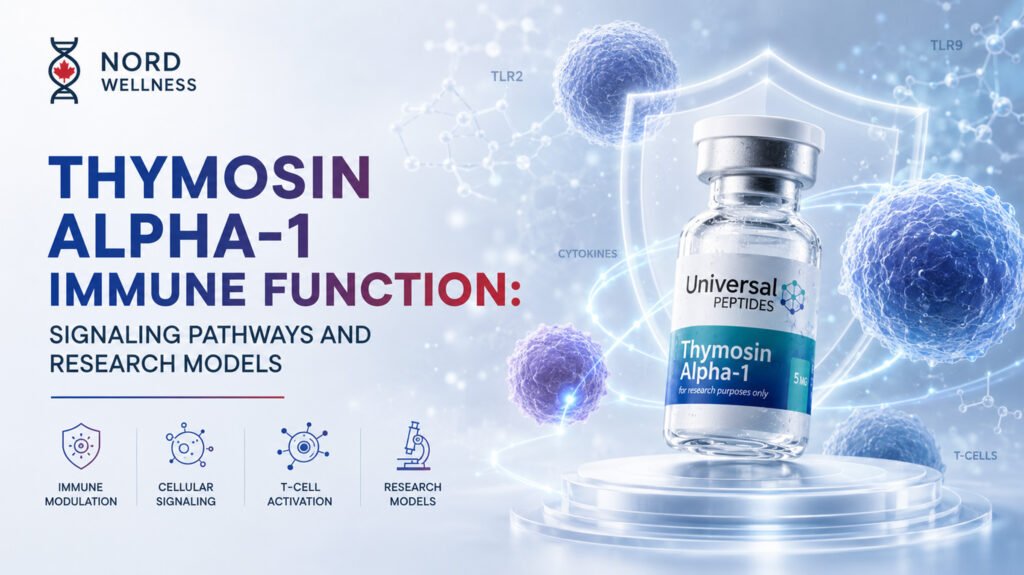
May
Thymosin Alpha-1 immune function is a major topic in peptide research because TA-1 is closely associated with immune regulation, T-cell biology, dendritic cell activity, cytokine signaling, and innate–adaptive immune communication. Also written as Tα1 or TA-1, Thymosin Alpha-1 is a 28-amino-acid thymic peptide studied as an immunomodulatory molecule across infection-related models, vaccine-response research, inflammation studies, and cancer-immunology systems. Research reviews describe TA-1 as a peptide with activity across T cells, dendritic cells, cytokines, chemokines, and Toll-like receptor pathways.
For researchers exploring immune-focused peptide science, Nord Wellness provides educational resources designed to support accurate, research-based understanding of peptide mechanisms, signaling pathways, and laboratory applications.
What Is the Immune Function of Thymosin Alpha-1?
The immune function of Thymosin Alpha-1 is best understood as immune modulation rather than simple immune stimulation. In other words, TA-1 is studied for how it may help regulate immune response patterns, cellular communication, and signaling balance under different experimental conditions.
The immune system relies on coordinated activity between innate and adaptive immune cells. TA-1 is especially relevant because research connects it to both sides of this system.
Innate immune research often focuses on dendritic cells, macrophages, natural killer cells, Toll-like receptor activity, cytokine signaling, and early immune recognition.
Adaptive immune research often focuses on T-cell maturation, T-cell activation, CD4+ and CD8+ T-cell response, antibody-related signaling, and immune memory models.
Thymosin Alpha-1 is valuable in research because it allows scientists to examine how one defined peptide sequence may influence several immune layers at once. Rather than acting as a single-pathway compound, TA-1 is usually discussed as a biological response modifier involved in immune coordination. Reviews describe TA-1 as affecting T-cell, dendritic-cell, antibody, cytokine, and chemokine responses, which explains why it appears across many immune-related research models.
👉 Explore TA-1 Peptide for research purposes at Thymosin Alpha-1 peptide
TA-1 and Immune Signaling Pathways
A central part of Thymosin Alpha-1 immune function is its relationship with immune signaling pathways. These pathways help immune cells identify signals, communicate with other cells, and coordinate appropriate responses.
One of the most discussed mechanisms involves Toll-like receptors, especially TLR2 and TLR9. Toll-like receptors are pattern-recognition receptors involved in innate immune detection. Research reviews describe Thymosin Alpha-1 as functioning through TLR9 and TLR2 activity in myeloid and dendritic cells, which are professional antigen-presenting cells.
This matters because dendritic cells help bridge innate and adaptive immunity. They detect signals, process antigens, and present information to T cells. When dendritic cell signaling changes, downstream T-cell activity and cytokine production may also change.
Key pathways and systems commonly discussed in TA-1 research include:
| Pathway or System | Research Relevance |
|---|---|
| TLR2 and TLR9 signaling | Involved in innate immune recognition and dendritic cell activation |
| Dendritic cell maturation | Supports antigen presentation and immune coordination models |
| T-cell signaling | Relevant to adaptive immune response and immune responsiveness |
| Cytokine and chemokine networks | Help measure immune-cell communication patterns |
| NK-cell activity | Studied in immune surveillance models |
| Antigen presentation | Connects innate recognition to adaptive immune activation |
TA-1 is therefore often studied not as a broad “immune booster,” but as a peptide that may influence how immune signaling systems communicate and organize.
Role in Cellular Communication Models
Immune function depends on communication. Cells do not act alone; they exchange signals through cytokines, chemokines, surface receptors, antigen presentation, and feedback loops. This is where Thymosin Alpha-1 becomes especially relevant in research.
In cellular communication models, TA-1 is often studied in relation to dendritic cells and T cells. Dendritic cells act as messengers that help introduce immune information to T cells. T cells then help coordinate adaptive immune responses through activation, differentiation, and cytokine release.
Research has described TA-1 as being involved in dendritic cell function, including maturation and antigen presentation. One study found that Thymosin Alpha-1 could modulate dendritic cell differentiation and function, supporting its relevance in immune-cell communication models.
TA-1 may be examined in models involving:
- Dendritic cell maturation markers
- T-cell activation response
- CD4+ and CD8+ T-cell signaling
- Cytokine release patterns
- Chemokine activity
- Antigen presentation response
- Innate-to-adaptive immune communication
This makes TA-1 useful for studying how immune cells coordinate responses under different experimental conditions. Its value is not only in whether a single marker increases or decreases, but in how the full immune communication network changes.
👉 Explore TA-1 Peptide for research purposes at Thymosin Alpha-1 peptide
Thymosin Alpha-1 in Immune-Related Research Systems
Thymosin Alpha-1 has been studied across several immune-related research systems because immune signaling is involved in many biological contexts. These include infection-related models, vaccine-response research, immune dysregulation studies, inflammation-related systems, and cancer-immunology models.
Infection-Related Immune Research
In infection-related research, scientists study how the immune system recognizes pathogens, activates defense responses, and regulates inflammation. Researchers have discussed TA-1 in viral infection and immune-compromised models because of its relationship with T-cell response, dendritic cell signaling, and cytokine regulation.
The research focus is usually not that TA-1 directly “kills” pathogens. Instead, researchers examine whether it may influence the immune environment that helps cells coordinate a response.
Vaccine-Response Research
TA-1 has also been studied as an immune-response modifier in vaccine-related contexts. This type of research often measures antibody response, T-cell response, dendritic cell activation, cytokine balance, and immune memory markers.
The most accurate framing is that TA-1 is studied in vaccine-response models, not that it guarantees stronger vaccine protection in all situations.
Cancer-Immunology Research
In cancer-immunology models, TA-1 is studied for its potential role in immune surveillance, T-cell signaling, dendritic cell function, cytokine networks, and tumor microenvironment research. A comprehensive review discusses TA-1 across malignancy-related and immune-related contexts, while also showing that its effects can be broad and model-dependent.
Inflammation and Cytokine Research
TA-1 is also relevant in inflammation research because immune activation and inflammatory signaling often overlap. Researchers may examine whether TA-1 affects cytokines such as IL-2, IFN-related markers, IL-6, TNF-α, IL-10, or chemokine activity.
This is important because immune function is not only about activation. A healthy research model often looks at regulation, timing, balance, and communication between immune signals.
Interaction with Peptide Signaling Networks
Thymosin Alpha-1 belongs to a broader field of peptide signaling research. Peptides can act as biological messengers, helping cells communicate, regulate pathways, and respond to environmental signals. TA-1 is especially interesting because it connects thymic peptide biology with immune-cell signaling.
Unlike structural peptides that are mainly studied for tissue architecture or repair models, TA-1 is primarily studied for immune communication. It is connected to networks involving:
- Dendritic cell signaling
- T-cell response
- Cytokine and chemokine expression
- Toll-like receptor pathways
- Antigen presentation
- Innate and adaptive immune coordination
This interaction with peptide signaling networks helps explain why TA-1 appears in many different research systems. A single immune signal can influence several downstream effects, including cell activation, cytokine production, migration signals, and adaptive immune response.
At the same time, this complexity means researchers must avoid oversimplifying TA-1. The peptide’s effects may depend on cell type, immune status, inflammatory trigger, timing, concentration, and study design. A response observed in one immune model may not appear the same way in another.
Research Limitations and Considerations
Although Thymosin Alpha-1 has a strong research history, writers should still interpret it responsibly. They should discuss TA-1 in a research context unless they refer to specific approved clinical uses in jurisdictions where those uses apply.
Key limitations include:
| Research Consideration | Why It Matters |
|---|---|
| Model differences | Cell, animal, and human data may not translate directly |
| Immune context | TA-1 may behave differently depending on baseline immune status |
| Pathway complexity | Immune signaling involves overlapping receptors, cytokines, and feedback loops |
| Study design | Small sample sizes or uncontrolled models can limit conclusions |
| Regulatory variation | Approval status and allowed use differ by country |
| Peptide quality | Purity, storage, and handling can affect research reliability |
Because TA-1 interacts with immune pathways, small experimental differences can affect results. Researchers should consider peptide concentration, exposure timing, cell type, inflammatory stimulus, endpoint selection, storage condition, and batch documentation.
For educational content, the safest and most accurate framing is this: Thymosin Alpha-1 is a research peptide studied for immune modulation, T-cell function, dendritic cell activity, cytokine signaling, and innate–adaptive immune communication.
To learn more about: Thymosin Alpha-1 Peptide: Structure, Immune Signaling, and Research Applications
FAQ — Thymosin Alpha 1 Immune Function
What is thymosin alpha 1 immune function?
Thymosin alpha 1 immune function refers to how TA-1 is studied in immune signaling, T-cell activity, dendritic cell function, cytokine regulation, and innate–adaptive immune communication. It is best described as an immunomodulatory peptide in research settings.
Is Thymosin Alpha-1 an immune booster?
It is more accurate to call Thymosin Alpha-1 an immunomodulatory peptide rather than simply an immune booster. Research focuses on how TA-1 may help regulate immune signaling patterns instead of only increasing immune activity.
How does TA-1 affect T cells?
TA-1 is studied in relation to T-cell maturation, activation, CD4+ and CD8+ T-cell response, and T-cell communication through cytokines. These areas are important for adaptive immune research.
How does TA-1 affect dendritic cells?
Dendritic cells are antigen-presenting cells that help connect innate and adaptive immunity. TA-1 has been studied for its relationship with dendritic cell maturation, antigen presentation, and Toll-like receptor signaling.
What signaling pathways are linked to Thymosin Alpha-1?
Researchers commonly discuss TA-1 in relation to TLR2, TLR9, dendritic cell signaling, T-cell response, cytokine networks, chemokine production, and antigen presentation pathways.
Is Thymosin Alpha-1 studied in vaccine-response research?
Yes. TA-1 has been studied in vaccine-response models where researchers examine immune responsiveness, antibody response, T-cell activation, dendritic cell signaling, and cytokine patterns. However, this should not be interpreted as a guaranteed clinical outcome.
Is TA-1 used in cancer-immunology research?
Yes. TA-1 appears in cancer-immunology research because of its relationship with immune surveillance, T-cell activity, dendritic cell function, and cytokine signaling. Its effects remain context-dependent and should be framed within research models.
Is Thymosin Alpha-1 approved for medical use?
Approval status varies by country and indication. Some literature discusses TA-1 clinical use in certain immune-related contexts internationally, but writers should not present it as universally approved for all uses or jurisdictions.
Final Thoughts
Thymosin Alpha-1 immune function is best understood through immune modulation, cellular communication, and signaling pathway research. As a 28-amino-acid thymic peptide, TA-1 is studied for its relationship with T-cell response, dendritic cell maturation, Toll-like receptor signaling, cytokine regulation, chemokine activity, antigen presentation, and innate–adaptive immune coordination.
Its value in research comes from its ability to help scientists explore how immune cells communicate and regulate response patterns across different models. However, because immune signaling is complex, TA-1 should not be reduced to a simple “immune booster” claim.
Disclaimer
This content is provided by Nord Wellness for educational and research purposes only. Thymosin Alpha-1 peptide is not approved for the diagnosis, treatment, cure, or prevention of any disease.



Pingback: Thymosin Alpha-1 Peptide: Structure, Immune Signaling, and Research Applications - nordwellness.ca
This article explained Thymosin Alpha-1’s role in immune signaling pathways in a very clear and professional way. I liked how it focused on the research models and cellular mechanisms instead of making exaggerated health claims. The discussion around immune modulation and signaling balance was especially interesting and gave the topic much more scientific depth.
Really informative read overall. A lot of peptide content online skips over the actual signaling biology, but this article did a great job explaining how Thymosin Alpha-1 interacts with immune-related pathways in research settings. I’d definitely be interested in reading more content comparing different immune-focused peptides side by side.
Great breakdown of a complex topic. The explanation of immune function, cytokine signaling, and research applications made the article feel both educational and accessible. It’s refreshing to see peptide articles that stay science-focused while still being easy for readers to follow.