

Immune & Specialized Peptides, Peptides, Thymosin Alpha-1
Thymosin Alpha-1 Mechanism: Cellular Signaling and Peptide Interaction
Summarize the article with:
 ChatGPT
 Claude
 Perplexity
 Google AI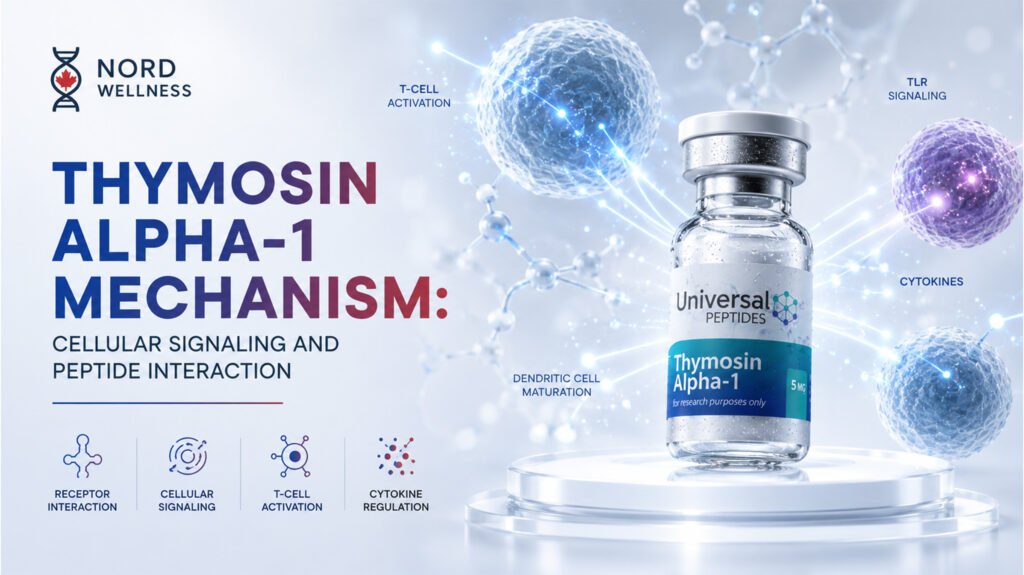
May
The Thymosin Alpha-1 mechanism is an important topic in peptide research because Thymosin Alpha-1, also known as TA-1 or Tα1, is closely connected to immune signaling, cellular communication, dendritic cell activity, T-cell response, cytokine regulation, and innate–adaptive immune coordination.
Unlike peptides that are mainly studied for structural repair, metabolic signaling, or hormone-related pathways, Thymosin Alpha-1 is most often examined as an immunomodulatory peptide. This means researchers study how it may influence immune response patterns, rather than simply increasing or suppressing immune activity in one direction.
As a 28-amino-acid thymic peptide, TA-1 provides a useful model for studying how peptide-based signaling may interact with immune cells, receptor-related pathways, cytokine networks, and cellular response systems.
For more science-based peptide education and immune-focused research insights, visit Nord Wellness
What Is the Mechanism of Thymosin Alpha-1?
The mechanism of Thymosin Alpha-1 refers to how TA-1 may interact with immune cells and signaling pathways in research models. Its activity is generally discussed in relation to immune modulation, cellular communication, and biological response regulation.
In research settings, TA-1 is commonly associated with several immune-related mechanisms, including dendritic cell maturation, T-cell activation, cytokine signaling, Toll-like receptor pathway interaction, and antigen presentation. These systems are closely connected because immune responses depend on communication between different cell types.
Thymosin Alpha-1 is not best understood as a simple immune stimulant. Instead, it is more accurately described as a peptide studied for its ability to influence immune signaling balance under specific experimental conditions.
Researchers often examine the thymosin alpha 1 mechanism through questions such as:
- How does TA-1 affect dendritic cell function?
- How does it influence T-cell signaling?
- Does TA-1 affect cytokine expression patterns?
- Which immune pathways are involved in its activity?
- How does TA-1 support innate–adaptive immune communication in research models?
These questions make TA-1 especially relevant in immunology, infection-related research, vaccine-response models, inflammation studies, and cancer-immunology systems.
👉 Explore TA-1 Peptide for research purposes at Thymosin Alpha-1 peptide
TA-1 and Peptide–Receptor Interactions
Peptide–receptor interaction is one of the most important concepts in understanding how Thymosin Alpha-1 may work. Peptides often function by interacting with cell-surface receptors or influencing receptor-associated signaling pathways. These interactions can trigger downstream cellular responses, including changes in gene expression, cytokine production, immune-cell activation, or communication between immune cell populations.
For TA-1, research often discusses its relationship with immune recognition pathways, especially those involving Toll-like receptors, commonly abbreviated as TLRs. TLRs are part of the innate immune system and help cells recognize biological signals associated with immune activation.
Two receptors frequently discussed in TA-1 research are:
- TLR2
- TLR9
These receptors are especially relevant in dendritic cells and other immune cells involved in antigen recognition and immune coordination.
When TA-1 is studied in relation to peptide–receptor interactions, the focus is usually not on one isolated binding event. Instead, researchers examine how TA-1 may influence broader receptor-associated signaling networks. This includes how immune cells detect signals, process information, and communicate with other cells.
In this context, TA-1 may be studied for its role in:
- Dendritic cell maturation
- Antigen presentation
- T-cell activation
- Cytokine signaling
- Innate immune recognition
- Adaptive immune response coordination
This receptor-related activity helps explain why TA-1 is often discussed as a biological response modifier. Its mechanism appears to involve communication across several immune systems rather than a single linear pathway.
Activation of Immune Signaling Pathways
A key part of the thymosin alpha 1 mechanism is its connection to immune signaling pathways. Immune signaling pathways help cells interpret external signals and respond through intracellular communication, gene expression, protein activity, and cytokine release.
TA-1 is studied across both innate immunity and adaptive immunity.
Innate immunity includes early immune-response systems such as dendritic cells, macrophages, natural killer cells, Toll-like receptors, and inflammatory cytokines.
Adaptive immunity involves more specialized immune responses, especially T cells, B cells, antigen presentation, and immune memory models.
Thymosin Alpha-1 is important because it may help researchers understand how these two immune branches communicate.
Key Immune Signaling Pathways Studied with TA-1
Toll-like receptor signaling is often discussed because TLRs help immune cells detect signals and initiate immune responses. TA-1 has been studied in relation to TLR2 and TLR9 pathways, especially in dendritic cell and innate immune models.
Dendritic cell signaling is another major area. Dendritic cells help present antigens to T cells and serve as a bridge between innate and adaptive immunity. TA-1 research often examines dendritic cell maturation, antigen presentation, and cytokine activity.
T-cell signaling is central to TA-1 research because the thymus plays a major role in T-cell development. TA-1 is often studied in models involving T-cell activation, CD4+ and CD8+ T-cell function, T-cell exhaustion, and adaptive immune responsiveness.
Cytokine signaling is also important because cytokines act as communication molecules between immune cells. Researchers may evaluate whether TA-1 affects markers such as IL-2, IFN-related signaling, IL-6, TNF-α, IL-10, and other cytokine networks.
Together, these pathways suggest that TA-1 is best understood as a peptide involved in immune signaling coordination rather than a single-target compound.
Effects on Cellular Communication Networks
Immune function depends heavily on cellular communication. Cells exchange information through cytokines, chemokines, receptors, antigen presentation, direct cell-to-cell contact, and feedback loops. TThymosin Alpha-1 is studied because it may influence several parts of this communication system.
One of the most important communication models involves dendritic cells and T cells.
Dendritic cells detect immune signals, process antigens, and present them to T cells. T cells then respond through activation, differentiation, cytokine release, and immune memory-related activity. If TA-1 influences dendritic cell function, it may also affect downstream T-cell communication.
In research models, TA-1 may be studied in relation to:
- Dendritic cell maturation markers
- Antigen presentation capacity
- CD4+ T-cell response
- CD8+ T-cell response
- Cytokine release patterns
- Chemokine signaling
- NK-cell activity
- Immune-cell coordination
This makes TA-1 especially relevant in studies where researchers want to understand how immune cells communicate under stress, infection-related conditions, inflammation-related models, or immune-compromised experimental systems.
Cytokines and Communication
Cytokines are central to cellular communication. They help immune cells send and receive signals, regulate inflammatory intensity, and coordinate immune responses.
In TA-1 research, cytokines may be studied to understand whether cellular communication patterns change under experimental conditions. Commonly discussed markers include:
- IL-2, which is linked to T-cell activation and growth signaling
- IFN-related markers, which are associated with antiviral and Th1-type immune responses
- IL-6, which is involved in inflammatory and immune-response signaling
- TNF-α, which is associated with inflammatory activation
- IL-10, which is linked to immune regulation and anti-inflammatory signaling
The goal of studying these cytokines is not simply to prove that TA-1 “boosts immunity.” Instead, researchers examine whether TA-1 may help regulate immune communication patterns in a measurable way.
👉 Explore TA-1 Peptide for research purposes at Thymosin Alpha-1 peptide
Molecular Stability and Degradation Pathways
Understanding molecular stability is essential when discussing the thymosin alpha 1 mechanism because peptide integrity can directly influence research reliability. Like other peptides, TA-1 may be sensitive to heat, moisture, light exposure, contamination, incorrect reconstitution, pH changes, and repeated freeze-thaw cycles.
If the peptide degrades, research outcomes may become inconsistent or misleading. This is especially important in immune studies because immune-cell models and cytokine assays can be sensitive to small differences in peptide quality, concentration, and handling.
Why Molecular Stability Matters
Peptide degradation may reduce or alter biological activity. If TA-1 loses structural integrity, the observed signaling response may not accurately reflect the intended peptide mechanism.
Contamination can also affect immune-focused experiments. Because immune cells are highly responsive to external signals, contamination may trigger unwanted cytokine responses or distort results.
Incorrect concentration is another important issue. If the peptide is not reconstituted accurately, the dose used in research models may be too high or too low, affecting interpretation.
Repeated freeze-thaw cycles may also contribute to peptide instability. For this reason, researchers often aliquot reconstituted peptide solutions to reduce repeated temperature stress.
General Stability Considerations
Thymosin Alpha-1 research should consider:
- Lyophilized peptide storage conditions
- Reconstitution solvent and concentration
- Storage temperature after reconstitution
- Protection from light and moisture
- Avoidance of repeated freeze-thaw cycles
- Batch documentation and certificate of analysis
- Purity and identity verification
- Sterile handling technique
These considerations are not minor details. They help ensure that the thymosin alpha 1 mechanism being studied reflects the peptide itself, rather than experimental artifacts caused by poor handling or degraded material.
Why TA-1 Is Studied in Immune Research
TA-1 is studied in immune research because it provides a useful peptide model for understanding immune coordination. Its connection to thymic biology, T-cell function, dendritic cell activity, and cytokine regulation makes it relevant across many research areas.
The main reason TA-1 is valuable is that immune responses are not controlled by one pathway. They involve multiple systems working together, including innate immune detection, antigen presentation, T-cell activation, cytokine signaling, chemokine communication, and regulatory feedback.
Thymosin Alpha-1 allows researchers to study these systems in a more focused way.
Common Research Areas for TA-1
Immune modulation research examines how TA-1 may influence immune response balance, especially in models where immune activity is dysregulated.
Vaccine-response research may study TA-1 in relation to antibody response, T-cell activation, dendritic cell function, cytokine signaling, and immune memory markers.
Infection-related immune research explores how TA-1 may influence immune signaling systems involved in host-response models.
Cancer-immunology research focuses on immune surveillance, T-cell response, dendritic cell activity, tumor microenvironment signaling, and cytokine networks.
Inflammation research examines how TA-1 may interact with inflammatory cytokines and immune-regulatory pathways.
Across all of these systems, the most accurate interpretation is that TA-1 is a research peptide studied for immune signaling and cellular communication—not a guaranteed therapeutic solution.
Research Limitations and Considerations
Although Thymosin Alpha-1 has been studied more extensively than many newer research peptides, responsible interpretation is still necessary. Immune signaling is complex, and results can vary depending on study design, cell type, concentration, immune status, endpoint selection, and experimental conditions.
Several limitations should be considered.
Cell-based studies do not always translate directly to animal or human outcomes. A signaling effect observed in one cell type may not behave the same way in a full biological system.
Immune context matters. TA-1 may produce different responses depending on whether the model involves immune suppression, chronic immune stress, acute inflammation, infection-related signaling, or baseline immune balance.
Study design also matters. Differences in dosage, timing, exposure duration, and measurement methods can change results.
Regulatory status can vary by country and use case. Therefore, TA-1 should be discussed carefully as a research peptide unless specific approved applications are being addressed within the correct jurisdiction.
To learn more about: Thymosin Alpha-1 Peptide: Structure, Immune Signaling, and Research Applications
FAQ – Thymosin Alpha 1 Mechanism
What is the mechanism of Thymosin Alpha-1?
The mechanism of Thymosin Alpha-1 is mainly studied through immune signaling, peptide–receptor interaction, dendritic cell activity, T-cell response, cytokine regulation, and innate–adaptive immune communication.
Is Thymosin Alpha-1 an immune booster?
It is more accurate to describe Thymosin Alpha-1 as an immunomodulatory peptide. Research focuses on how TA-1 may influence immune signaling balance rather than simply boosting immune activity.
What receptors are linked to TA-1 research?
TA-1 is often discussed in relation to Toll-like receptor pathways, especially TLR2 and TLR9. These pathways are relevant to innate immune recognition and dendritic cell signaling.
How does TA-1 affect T cells?
TA-1 is studied in relation to T-cell activation, T-cell maturation, CD4+ and CD8+ T-cell response, cytokine output, and adaptive immune signaling models.
How does TA-1 affect dendritic cells?
Dendritic cells are important antigen-presenting cells. TA-1 research often examines dendritic cell maturation, antigen presentation, Toll-like receptor signaling, and communication with T cells.
Why is cytokine regulation important in TA-1 research?
Cytokines are signaling proteins that help immune cells communicate. In TA-1 research, cytokine markers help scientists evaluate immune response patterns and cellular communication changes.
Does peptide stability affect TA-1 research?
Yes. Peptide stability can affect research reliability. Degradation, contamination, incorrect concentration, and repeated freeze-thaw cycles may influence experimental outcomes.
Is TA-1 approved for medical use?
Approval status varies by country and indication. In research-focused content, TA-1 should be discussed as a peptide studied for immune signaling, cellular communication, and immune modulation unless a specific approved clinical context is being referenced.
Final Thoughts
The Thymosin Alpha-1 mechanism is best understood through immune signaling, peptide–receptor interaction, cellular communication, cytokine regulation, and dendritic cell–T-cell coordination. As a 28-amino-acid thymic peptide, TA-1 gives researchers a focused model for studying how peptide-based signaling may influence immune response patterns.
Its relevance extends across immune modulation research, infection-related models, vaccine-response systems, inflammation studies, and cancer-immunology research. However, TA-1 should not be reduced to a simple “immune booster” claim. Its mechanism is more accurately described as immune signaling modulation within specific research conditions.
Disclaimer
This content is provided by Nord Wellness for educational and research purposes only. Thymosin Alpha-1 peptide is not approved for the diagnosis, treatment, cure, or prevention of any disease.



This article provided a really solid explanation of how Thymosin Alpha-1 interacts with cellular signaling and peptide communication pathways. I appreciated that the focus stayed on mechanisms and research applications instead of exaggerated claims. The section discussing immune-cell interaction and signaling balance was especially insightful.
Really informative read overall. A lot of peptide content online oversimplifies immune signaling, but this article explained the cellular interactions in a much more professional and understandable way. I’d love to see more content exploring how TA1 compares with other immunomodulatory peptides in current research models.
Great breakdown of a complex peptide topic. The explanation of cellular signaling pathways and peptide interaction mechanisms made the science much easier to follow without losing technical depth. It’s refreshing to find research-focused peptide articles that still feel accessible to general readers.
Pingback: Thymosin Alpha-1 Peptide: Structure, Immune Signaling, and Research Applications - nordwellness.ca