

GHRP 6, Growth Hormone Inducing Peptides, Peptides
GHRP-6 Mechanism: Ghrelin Receptor Activation and Signal Pathways
Summarize the article with:
 ChatGPT
 Claude
 Perplexity
 Google AI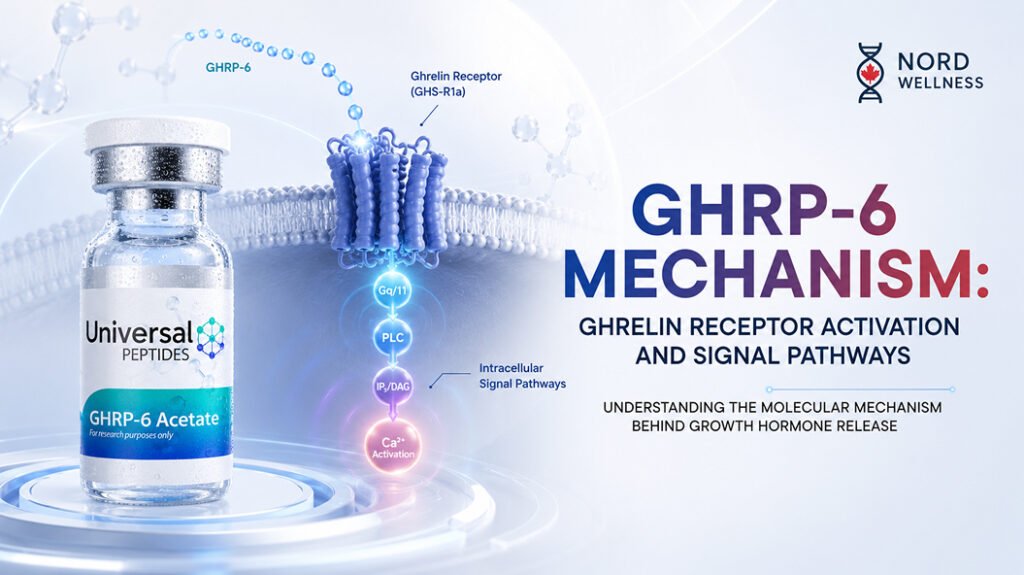
Jun
GHRP-6(Growth Hormone Releasing Peptide-6) is a synthetic peptide widely studied in metabolic and endocrine research for its ability to stimulate growth hormone (GH) release through the ghrelin receptor, also known as GHS-R1a. Understanding the mechanism of GHRP-6 provides insights into growth hormone signaling, receptor pharmacology, and downstream metabolic pathways.
GHRP-6 is primarily a research tool used in laboratory or clinical investigation settings to study GH dynamics, tissue repair, and endocrine feedback. It should not be interpreted as a consumer supplement or performance-enhancing product.
This article explores GHRP-6’s mechanism, receptor binding, signal transduction, endocrine interactions, and its relevance in hormone signaling research.
What Is the Mechanism of GHRP-6?
GHRP-6 works by mimicking ghrelin, an endogenous peptide hormone, to stimulate the growth hormone secretagogue receptor (GHS-R1a). Upon binding, GHRP-6 triggers intracellular signaling that leads to GH release from the anterior pituitary.
Key aspects of its mechanism include:
- Activation of GH pulsatility in research models
- Induction of GH peak secretion for experimental observation
- Engagement with central and peripheral endocrine systems
- Modulation of appetite and energy regulation via hypothalamic signaling
By targeting GHS-R1a, GHRP-6 allows researchers to study the physiological roles of ghrelin signaling and the regulation of growth hormone pathways.
👉 Explore GHRP-6 Peptide for research purposes at GHRP-6 Peptide
GHRP-6 and GHS-R1a (Ghrelin Receptor) Binding
GHS-R1a is a G-protein coupled receptor (GPCR) expressed primarily in the pituitary, hypothalamus, and other endocrine tissues. GHRP-6 binds selectively to this receptor, initiating downstream signaling cascades that result in GH secretion.
Receptor binding characteristics:
- High affinity for GHS-R1a
- Activation of intracellular Gq and Gi pathways
- Triggering of calcium mobilization and phospholipase C (PLC) activity
- Stimulation of GH release without direct receptor agonism at other pathways
This selective receptor binding makes GHRP-6 a valuable tool for research into ghrelin receptor pharmacology and GH dynamics.
Activation of Growth Hormone Signaling Pathways
Upon receptor engagement, GHRP-6 stimulates a cascade of intracellular events:
- GH Secretion: Pituitary somatotrophs release growth hormone into circulation
- IGF-1 Production: GH acts on the liver to produce insulin-like growth factor 1 (IGF-1), mediating anabolic effects
- Protein and Fat Metabolism: GH and IGF-1 influence protein synthesis, lipolysis, and energy partitioning
- Endocrine Feedback: GH and IGF-1 feedback to the hypothalamus to modulate GHRH and somatostatin release
This pathway allows researchers to explore GH-related signaling, tissue remodeling, and metabolic outcomes in controlled experimental settings.
👉 Explore GHRP-6 Peptide for research purposes at GHRP-6 Peptide
GHRP-6 and Signal Transduction Mechanisms
GHRP-6 binding to GHS-R1a activates multiple intracellular signaling pathways:
- PLC-IP3-Ca²⁺ Pathway: Leads to intracellular calcium mobilization and GH vesicle exocytosis
- cAMP Pathway: Modulates GH release and amplifies endocrine response
- MAPK/ERK Pathway: Influences gene expression and somatotroph sensitivity
- PI3K-Akt Signaling: Contributes to metabolic and anabolic regulation
These signal transduction mechanisms make GHRP-6 a versatile compound for research into endocrine regulation and GH receptor pharmacology.
Interaction with Endocrine Feedback Systems
GHRP-6 does not act in isolation; it interacts with multiple feedback loops:
- Somatostatin: Inhibitory hormone that regulates GH pulsatility
- GHRH (Growth Hormone Releasing Hormone): Works synergistically with GHRP-6 to enhance GH release
- IGF-1 Feedback: GH-induced IGF-1 exerts negative feedback on GH secretion
- Ghrelin Regulation: Endogenous ghrelin and GHRP-6 compete or complement receptor activation in research models
Studying these interactions helps researchers understand how GH dynamics are controlled at both the pituitary and hypothalamic levels.
Why GHRP-6 Is Studied in Hormone Signaling Research
GHRP-6 is valuable in research because it allows for:
- Controlled GH stimulation: Precise study of GH secretion patterns
- Receptor pharmacology exploration: Understanding GHS-R1a and GPCR signaling
- Metabolic research: Investigation of protein, fat, and glucose regulation
- Tissue repair studies: Insights into anabolic signaling and recovery models
- Combination studies: Evaluation alongside other GH secretagogues or peptides
Its reproducible mechanism makes it a preferred model compound for endocrine research and growth hormone physiology studies.
Learn more in our full guide: GHRP-6 Peptide: Mechanism, Growth Hormone Signaling, and Research Applications.
FAQ – GHRP 6 Mechanism
1. What is the mechanism of GHRP-6?
GHRP-6 activates the ghrelin receptor (GHS-R1a) to stimulate GH release from the pituitary and downstream endocrine signaling.
2. How does GHRP-6 bind the ghrelin receptor?
It selectively binds GHS-R1a, triggering intracellular pathways including calcium mobilization, PLC activation, and MAPK/ERK signaling.
3. What is the role of GHRP-6 in GH signaling?
GHRP-6 induces growth hormone release, which stimulates IGF-1 production, anabolic pathways, and metabolic regulation in research models.
4. Does GHRP-6 affect endocrine feedback?
Yes. GH and IGF-1 feedback modulate hypothalamic GHRH and somatostatin, while GHRP-6 interacts with these loops in research contexts.
5. Is GHRP-6 a supplement?
No. GHRP-6 is strictly a research peptide studied under controlled laboratory or clinical investigation conditions.
6. What are common research applications of GHRP-6?
It is used to study GH dynamics, receptor pharmacology, tissue repair, metabolic regulation, and combination peptide studies.
Final Thoughts
GHRP-6 provides a unique window into growth hormone physiology, ghrelin receptor activation, and metabolic signaling pathways. Its mechanism involves precise receptor binding, intracellular signal transduction, and interaction with complex endocrine feedback systems, making it an essential tool in peptide and hormone signaling research.
Disclaimer
This content is provided by Nord Wellness for educational and research purposes only. GHRP-6 Peptide is not approved for the diagnosis, treatment, cure, or prevention of any disease.



This was a very informative explanation of the GHRP-6 mechanism and the signaling pathways involved. I appreciated how the article focused on receptor activation and growth hormone-related signaling rather than just discussing potential outcomes. The section covering ghrelin receptor interaction provided a much clearer understanding of why GHRP-6 remains relevant in peptide research.
Great article overall. Many peptide resources mention GHRP-6 but don’t go into much detail about the underlying biology. This article did a great job breaking down receptor interactions, downstream signaling, and the broader role of GHRP-6 in endocrine research. I’d love to see
Really enjoyed reading this article. The explanation of peptide signaling, cellular communication, and endocrine pathway activity was detailed enough to be educational while still remaining easy to follow. It’s refreshing to find research-focused content that presents complex mechanisms in such a clear and balanced way.
Pingback: GHRP-6 Peptide: Mechanism, Growth Hormone Signaling, and Research Applications - nordwellness.ca