

GHRP 6, Growth Hormone Inducing Peptides, Peptides
GHRP-6 Peptide: Mechanism, Growth Hormone Signaling, and Research Applications
Summarize the article with:
 ChatGPT
 Claude
 Perplexity
 Google AI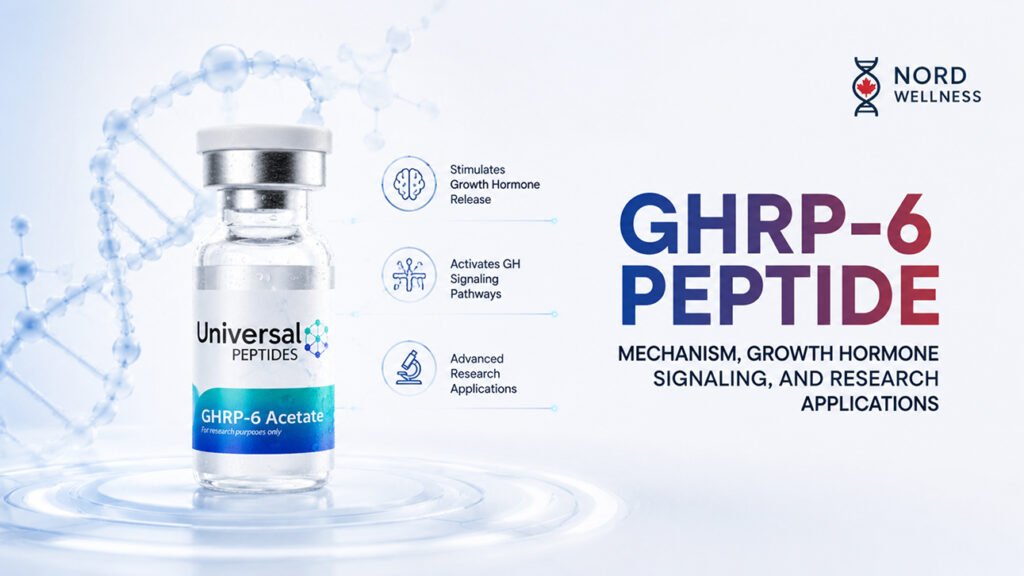
Jun
GHRP-6 (Growth Hormone Releasing Peptide-6) is a synthetic peptide widely studied in metabolic and endocrine research for its ability to stimulate growth hormone (GH) release through the ghrelin receptor (GHS-R1a). Its unique mechanism and receptor interactions make it a valuable tool in understanding growth hormone signaling, tissue repair, energy metabolism, and endocrine feedback loops.
Unlike commercial claims often circulated online, researchers should view GHRP-6 strictly as a research peptide. They use it in laboratory and clinical studies under controlled conditions, focusing on mechanism, receptor activity, and metabolic outcomes.
This article explores GHRP-6’s structure, mechanism, signaling pathways, research applications, and laboratory considerations. In addition, it highlights key factors for understanding how this peptide is used in controlled research settings.
What Are GHRP-6 Peptide?
GHRP-6 is a synthetic hexapeptide designed to mimic the activity of ghrelin, the endogenous “hunger. Unlike natural ghrelin, which has a short half-life, researchers engineered GHRP-6 to be more stable and to reliably stimulate growth hormone release in experimental models.
Research studies have used GHRP-6 to investigate:
- Growth hormone release dynamics
- GH pulsatility
- Endocrine feedback regulation
- Tissue repair and anabolic processes
- Metabolic adaptation in preclinical models
Because GHRP-6 interacts with complex endocrine systems, it is important to understand its mechanism at the receptor and cellular level.
👉 Explore GHRP-6 Peptide for research purposes at GHRP-6 Peptide
Structure and Classification of GHRP-6
GHRP-6 is a small peptide composed of six amino acids. Specifically, its sequence and structural modifications enable it to:
- Bind selectively to GHS-R1a (ghrelin receptor)
- Trigger intracellular signaling cascades associated with growth hormone release
- Resist rapid enzymatic degradation for reliable experimental observation
In terms of classification, GHRP-6 belongs to the growth hormone releasing peptide (GHRP) family. Specifically, other members include GHRP-2, ipamorelin, and hexarelin, each with slightly different receptor selectivity, potency, and metabolic effects.
Structurally, GHRP-6 is characterized by:
- High receptor affinity for GHS-R1a
- Small molecular weight, facilitating diffusion and receptor interaction
- Enhanced stability compared with native ghrelin in laboratory models
This structural profile allows researchers to investigate GH-related signaling without relying solely on endogenous ghrelin, which degrades rapidly. Consequently, it provides a more stable model for studying growth hormone pathways.
Role of GHRP-6 in Ghrelin Receptor (GHS-R1a) Activation
The primary mechanism of GHRP-6 is the activation of the growth hormone secretagogue receptor type 1a (GHS-R1a). Moreover, researchers have found this receptor expressed in the pituitary, hypothalamus, and other tissues involved in endocrine regulation.
When GHRP-6 binds GHS-R1a, it:
- Triggers GH-releasing intracellular pathways
- Stimulates the anterior pituitary to release growth hormone
- Interacts with feedback loops involving IGF-1, somatostatin, and other endocrine regulators
- Influences appetite and energy metabolism via hypothalamic signaling
Preclinical research shows that GHRP-6’s receptor activation can increase GH pulsatility and peak concentration. As a result, this is critical for studies exploring anabolic signaling, tissue repair, and metabolic regulation.
It is important to note that GHRP-6 works indirectly to enhance metabolic and tissue-related outcomes through GH release rather than directly causing anabolic effects.
👉 Explore GHRP-6 Peptide for research purposes at GHRP-6 Peptide
Growth Hormone Signaling and Endocrine Research
Once GHRP-6 stimulates GH release, the hormone interacts with downstream endocrine and metabolic pathways:
- IGF-1 Production: GH acts on the liver to stimulate IGF-1 secretion, which mediates many anabolic and tissue repair effects
- Protein Synthesis: IGF-1 and GH together influence protein synthesis, amino acid uptake, and muscle remodeling in experimental models
- Glucose Metabolism: GH affects insulin sensitivity and glucose utilization, a key consideration in endocrine research
- Fat Metabolism: GH influences lipolysis and energy mobilization in preclinical studies
- Neuroendocrine Feedback: GH and IGF-1 modulate hypothalamic somatostatin and ghrelin secretion, creating tightly regulated feedback loops
Researchers studying GHRP-6 can examine both acute GH responses and longer-term endocrine adaptations, making it a versatile tool in experimental metabolic and anabolic studies.
Common Research Applications of GHRP-6
GHRP-6 has been used extensively in laboratory and clinical research to explore:
- Growth Hormone Dynamics: Studying pulsatile GH release, peak concentrations, and receptor pharmacology
- Metabolic Research: Understanding GH-mediated energy balance, protein and fat metabolism
- Tissue Repair and Recovery: Investigating effects on muscle repair, wound healing, and anabolic signaling
- Endocrine Feedback Studies: Evaluating hypothalamic-pituitary axis regulation and interactions with ghrelin and somatostatin
- Combination Studies: Assessing synergistic effects with other peptides or GH secretagogues in experimental protocols
These applications provide insight into GH physiology, receptor pharmacology, and metabolic regulation. Furthermore, they help researchers design subsequent studies with translational relevance.
Storage, Stability, and Research Considerations
Peptide stability is critical for reliable research outcomes. GHRP-6, like other research peptides, requires careful handling:
- Lyophilized Storage: Keep in cold, dry conditions, protected from light
- Reconstitution: Follow sterile technique and laboratory protocols; reconstituted peptides are less stable than lyophilized forms
- Aliquoting: Avoid repeated freeze-thaw cycles to maintain structural integrity
- Documentation: Track lot number, purity, concentration, storage temperature, and experimental usage
- Research-Only Use: GHRP-6 should only be handled in research or clinical investigation settings. In other words, it is not approved as a consumer or performance supplement.
Proper handling ensures experimental reliability and maintains safety standards in peptide research. In other words, careful storage, reconstitution, and usage practices are essential for producing consistent and trustworthy results.
👉 SEE MORE:
- GHRP-6 Mechanism: Ghrelin Receptor Activation and Signal Pathways
- How GHRP-6 Works: Ghrelin Receptor and Hormone Signaling Explained
FAQ – GHRP 6 Peptide
1. What is GHRP-6?
GHRP-6 is a synthetic hexapeptide that stimulates growth hormone release by activating the ghrelin receptor (GHS-R1a).
2. How does GHRP-6 work?
It binds to GHS-R1a, triggering GH secretion from the anterior pituitary and influencing downstream endocrine pathways. As a result, GHRP-6 is commonly studied to understand growth hormone regulation and related metabolic effects.
3. What receptors does GHRP-6 interact with?
GHRP-6 primarily interacts with GHS-R1a (ghrelin receptor). In turn, this receptor is expressed in the pituitary, hypothalamus, and other endocrine tissues.
4. What is its role in metabolic research?
GHRP-6 is used to study GH dynamics, metabolic regulation, energy balance, tissue repair, and endocrine feedback mechanisms.
5. Is GHRP-6 a weight-loss or anabolic supplement?
No. Instead, it is a research peptide used to study growth hormone pathways. Researchers explore its effects in humans under controlled experimental conditions, rather than for casual supplementation.
6. How should GHRP-6 be stored?
Researchers should store lyophilized GHRP-6 in cold, dry conditions and protect it from light. In addition, they should aliquot and handle reconstituted solutions carefully to avoid degradation.
7. Can GHRP-6 be combined with other peptides?
In research, GHRP-6 is sometimes studied in combination with other GH secretagogues to examine synergistic effects. Importantly, all combinations should follow proper experimental design and safety protocols.
Final Thoughts
GHRP-6 is a key research peptide for understanding growth hormone signaling, ghrelin receptor activity, and metabolic regulation. By stimulating GH release and influencing endocrine and metabolic pathways, it provides a valuable tool for experimental studies on tissue repair, energy balance, and neuroendocrine feedback. As a result, researchers can use GHRP-6 to model and investigate complex physiological processes in a controlled setting.
Its unique receptor-mediated mechanism and long-standing research applications make it an important model compound in peptide science. Consequently, GHRP-6 continues to be widely referenced in studies of growth hormone signaling and related metabolic pathways. As with all research peptides, GHRP-6 should be handled exclusively within laboratory or clinical investigation frameworks.
Disclaimer
This content is provided by Nord Wellness for educational and research purposes only. GHRP-6 Peptide is not approved for the diagnosis, treatment, cure, or prevention of any disease.



This was a really informative overview of GHRP-6 and its role in growth hormone signaling research. I appreciated how the article explained the peptide’s mechanism and receptor interactions in a way that was detailed but still easy to follow. The section discussing appetite signaling and metabolic pathways added a lot of useful context.
Great article overall. Many peptide resources focus only on potential outcomes, but this piece did a good job explaining the biological mechanisms behind GHRP-6 and why it remains relevant in research discussions. I’d be interested in reading a comparison between GHRP-6, GHRP-2, and Ipamorelin in a future post.
Really enjoyed reading this article. The explanation of growth hormone release, cellular signaling, and peptide research applications was balanced and educational. It’s refreshing to find content that stays focused on the science while still being accessible to readers who are new to peptide research.
Pingback: GHRP-6 Mechanism: Ghrelin Receptor Activation and Signal Pathways - nordwellness.ca
Pingback: How GHRP-6 Works: Ghrelin Receptor and Hormone Signaling Explained - nordwellness.ca