

GHRP 6, Growth Hormone Inducing Peptides, Peptides
How GHRP-6 Works: Ghrelin Receptor and Hormone Signaling Explained
Summarize the article with:
 ChatGPT
 Claude
 Perplexity
 Google AI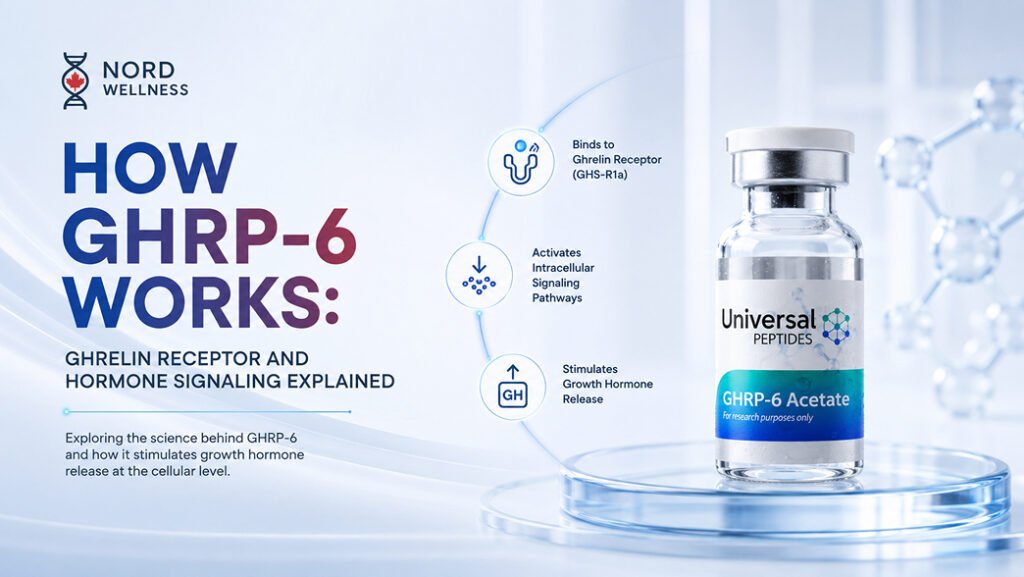
Jun
GHRP-6 (Growth Hormone Releasing Peptide-6) is a synthetic peptide widely used in metabolic and endocrine research for its ability to stimulate growth hormone (GH) release. Understanding how GHRP-6 works requires a detailed look at its interaction with the ghrelin receptor (GHS-R1a), downstream signaling pathways, and the broader endocrine system.
Unlike marketing claims circulating online, GHRP-6 should be considered strictly as a research peptide, studied in controlled experimental settings to explore growth hormone dynamics, tissue repair, and hormone signaling mechanisms.
This article provides a comprehensive, research-focused overview of GHRP-6’s mechanism, receptor activity, metabolic implications, and unique features in peptide science.
How Does GHRP-6 Work in the Body?
GHRP-6 functions as a ghrelin analogue, binding to the growth hormone secretagogue receptor type 1a (GHS-R1a). This binding triggers a cascade of intracellular events that result in the secretion of GH from anterior pituitary somatotrophs.
Key aspects of its mechanism:
- Activation of GH pulsatility and peak secretion in research models
- Engagement with central and peripheral endocrine systems
- Induction of intracellular signal transduction pathways
- Influence on energy balance and appetite regulation via hypothalamic signaling
Through these processes, GHRP-6 allows researchers to study GH-related physiological and metabolic outcomes in controlled laboratory environments.
👉 Explore GHRP-6 Peptide for research purposes at GHRP-6 Peptide
GHRP-6 and Ghrelin Receptor Activation Explained
The GHS-R1a receptor is a G-protein coupled receptor expressed in the pituitary, hypothalamus, and other tissues involved in endocrine regulation. GHRP-6 binds selectively to GHS-R1a, activating intracellular signaling pathways that lead to GH release.
Receptor binding features:
- High affinity and selectivity for GHS-R1a
- Activation of Gq and Gi protein-mediated pathways
- Mobilization of intracellular calcium
- Stimulation of GH vesicle exocytosis without off-target receptor activation
This precise receptor interaction is why GHRP-6 is valuable in studies exploring ghrelin receptor pharmacology and GH secretion dynamics.
Effects on Growth Hormone Signaling
After GHS-R1a activation, GHRP-6 stimulates several growth hormone-related processes:
- GH Release: Increased secretion of growth hormone from pituitary cells
- IGF-1 Production: GH induces hepatic insulin-like growth factor 1 (IGF-1), mediating anabolic and tissue repair effects
- Protein and Fat Metabolism: IGF-1 and GH influence protein synthesis, lipolysis, and energy partitioning
- Endocrine Feedback: GH and IGF-1 regulate hypothalamic somatostatin and GHRH, modulating further GH release
These mechanisms make GHRP-6 a versatile tool for researchers studying GH dynamics, tissue regeneration, and metabolic regulation.
GHRP-6 and Endocrine System Interaction
GHRP-6 interacts with complex endocrine feedback loops, including:
- Somatostatin Inhibition: Reduces GH suppression to allow greater secretion
- GHRH Synergy: Enhances GH release when combined with growth hormone releasing hormone
- IGF-1 Feedback: Modulates GH secretion through negative feedback
- Endogenous Ghrelin Interaction: Competes with or complements native ghrelin in research models
These interactions provide insight into how GH pulsatility and amplitude are regulated at both the hypothalamic and pituitary levels.
👉 Explore GHRP-6 Peptide for research purposes at GHRP-6 Peptide

Role in Experimental Metabolic Models
GHRP-6 is extensively used in experimental metabolic models to explore:
- GH secretion dynamics and receptor pharmacology
- Tissue repair and anabolic signaling
- Appetite regulation and energy balance
- Endocrine feedback loops and neuroendocrine integration
- Combination studies with other GH secretagogues
By modulating GH and IGF-1 pathways, GHRP-6 allows researchers to investigate both acute hormonal responses and longer-term metabolic adaptations.
What Makes GHRP-6 Unique Among Peptides?
GHRP-6 is distinguished by several features:
- Selective Long-Acting GH Stimulation: Provides sustained receptor engagement compared to native ghrelin
- Complex Receptor Interaction: Specifically targets GHS-R1a while sparing off-target pathways
- Neuroendocrine Integration: Influences appetite, satiety, and energy balance via central and peripheral pathways
- Research Versatility: Useful in combination studies, metabolic research, tissue repair, and GH receptor pharmacology
- Translational Relevance: Its mechanism helps explain peptide receptor pharmacology and endocrine regulation
Learn more in our full guide: GHRP-6 Peptide: Mechanism, Growth Hormone Signaling, and Research Applications.
FAQ – How GHRP-6 Works
1. How does GHRP-6 work?
GHRP-6 activates the ghrelin receptor (GHS-R1a), stimulating growth hormone release and downstream endocrine signaling.
2. What is the receptor for GHRP-6?
GHS-R1a (growth hormone secretagogue receptor type 1a) is located in the pituitary and hypothalamus.
3. What pathways does GHRP-6 influence?
It triggers GH release, IGF-1 production, protein and fat metabolism, and neuroendocrine feedback loops.
4. Is GHRP-6 a supplement?
No. GHRP-6 is strictly a research peptide intended for laboratory or clinical investigation.
5. What are its research applications?
Used to study GH dynamics, tissue repair, metabolic regulation, endocrine feedback, and combination peptide research.
6. Does GHRP-6 affect appetite?
Yes, indirectly, via hypothalamic ghrelin receptor activation and central signaling related to energy balance.
7. How is it unique among peptides?
It provides selective, long-acting GH stimulation, engages complex receptor systems, and integrates neuroendocrine and metabolic pathways for research purposes.
Final Thoughts
GHRP-6 provides a controlled mechanism to study growth hormone dynamics, ghrelin receptor activation, and endocrine feedback in metabolic research. Its receptor specificity, signal transduction pathways, and neuroendocrine interactions make it an essential tool for understanding GH physiology, tissue repair, and energy balance in experimental models.
For more in-depth peptide research insights and educational content, explore Nord Wellness for additional resources on GHRP-6 and related GH secretagogues.
Disclaimer
This content is provided by Nord Wellness for educational and research purposes only. GHRP-6 Peptide is not approved for the diagnosis, treatment, cure, or prevention of any disease.



This was a great explanation of how GHRP-6 works and its role in growth hormone signaling research. I liked how the article broke down receptor interactions and downstream cellular responses in a way that was detailed but still easy to understand. It would be interesting to see a future article comparing how GHRP-6 and other growth hormone secretagogues differ in their signaling mechanisms.
Really informative read overall. Many articles mention GHRP-6 but don’t spend much time explaining the biological pathways involved. This article did a great job connecting growth hormone release, receptor activation, and metabolic signaling into a clear and logical overview.
Pingback: GHRP-6 Peptide: Mechanism, Growth Hormone Signaling, and Research Applications - nordwellness.ca
I really appreciated the research-focused approach of this article. The discussion around signaling pathways and endocrine regulation provided much more depth than most peptide content available online. It’s refreshing to find educational material that stays science-based while remaining accessible to readers who are still learning about peptide research.