

Immune & Specialized Peptides, Peptides, SS-31
How SS-31 Peptide Works: Mitochondrial Function, Cellular Energy, and Research Insights
Summarize the article with:
 ChatGPT
 Claude
 Perplexity
 Google AI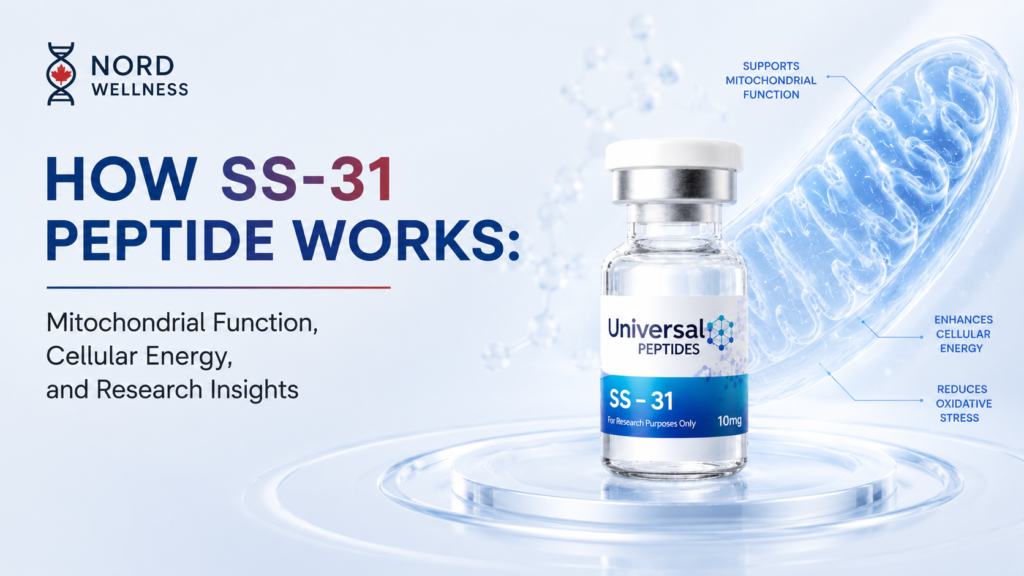
Jul
SS-31 Peptide, also known as Elamipretide, is a mitochondria-targeted tetrapeptide that has attracted significant attention in cellular and metabolic research. By interacting selectively with mitochondrial membranes, SS-31 helps preserve mitochondrial integrity, reduce oxidative stress, and enhance ATP production. Understanding how SS-31 works provides researchers with a unique tool for studying cellular bioenergetics, cytoprotection, and the mechanisms underlying mitochondrial dysfunction.
This article provides a comprehensive overview of SS-31’s mechanism, its effects on mitochondria and cellular energy, and current research findings, offering a valuable resource for students, researchers, and enthusiasts interested in mitochondrial science.
What Is SS-31 Peptide?
SS-31 is a synthetic tetrapeptide composed of D-Arg-DimethylTyr-Lys-Phe-NH2. Its small size and lipophilic nature allow it to penetrate cell membranes and accumulate in mitochondria.
Key characteristics include:
- Mitochondrial selectivity: Targets cardiolipin-rich inner mitochondrial membranes.
- ROS modulation: Reduces reactive oxygen species and prevents oxidative damage.
- ATP support: Enhances mitochondrial energy production by stabilizing electron transport chain efficiency.
Researchers primarily use SS-31 in research contexts to study energy metabolism, oxidative stress mitigation, and mitochondrial resilience under stress conditions.
👉 Explore SS-31 Peptide for research purposes at SS-31 Peptide
How SS-31 Peptide Works
SS-31 works by binding selectively to cardiolipin, a phospholipid unique to the inner mitochondrial membrane. This interaction stabilizes the mitochondrial membrane and improves the efficiency of the electron transport chain (ETC).
The mechanism can be summarized as:
- Mitochondrial targeting: SS-31 enters the cell and accumulates in mitochondria due to its cationic and lipophilic properties.
- Cardiolipin stabilization: SS-31 binds cardiolipin, maintaining structural integrity of the inner membrane and ETC complexes.
- Reduction of reactive oxygen species (ROS): Improved ETC efficiency decreases electron leakage and ROS formation.
- Enhanced energy production: Mitochondrial ATP synthesis is improved, supporting cellular energy demands.
By targeting these pathways, SS-31 allows researchers to explore how mitochondrial stabilization affects cellular metabolism and resilience under stress. As a result, it provides a controlled model for investigating energy regulation and cytoprotective mechanisms.
SS-31 and Mitochondrial Membranes
Mitochondrial membranes, particularly the inner membrane, are critical for maintaining electrochemical gradients required for ATP production. Cardiolipin, a unique mitochondrial lipid, is essential for maintaining the structural organization of the ETC.
SS-31 interacts specifically with cardiolipin, providing several protective effects:
- Prevents lipid peroxidation, which can damage membrane proteins and ETC complexes
- Preserves mitochondrial membrane potential, ensuring proper proton gradient maintenance
- Reduces structural damage caused by oxidative stress or metabolic dysfunction
These actions make SS-31 an invaluable research tool for studying mitochondrial health and pathology, including models of cardiovascular disease, neurodegeneration, and metabolic disorders.
👉 Explore SS-31 Peptide for research purposes at SS-31 Peptide
Effects on Cellular Energy Production
By stabilizing mitochondrial membranes and reducing ROS, SS-31 enhances the efficiency of ATP production. Improved energy output benefits cells with high metabolic demand, such as cardiac and neural cells.
Research has shown that SS-31:
- Increases mitochondrial ATP synthesis efficiency
- Reduces oxidative damage to proteins and lipids involved in energy metabolism
- Preserves cellular energy homeostasis under stress conditions
These effects are particularly valuable in laboratory studies that explore metabolic resilience, ischemia-reperfusion injury, or age-related mitochondrial decline.
Current Research Findings
Preclinical studies of SS-31 have revealed several important observations:
- Mitochondrial protection: SS-31 reduces oxidative stress and maintains membrane integrity in multiple tissue types.
- Enhanced bioenergetics: Improved ATP production is observed in muscle, cardiac, and neuronal cells.
- Cytoprotection: SS-31 protects cells from oxidative injury and apoptosis in in vitro and animal models.
- Potential therapeutic relevance: Although primarily used in research, findings suggest potential application for mitochondrial dysfunction in cardiovascular, neurological, and metabolic disorders.
Limitations: Most data on SS-31 come from preclinical studies. Researchers have not fully established its long-term systemic effects in humans and note that further research is needed to confirm translational relevance.
For a deeper understanding of SS-31 peptide, including its mechanism, mitochondrial function, research applications, and benefits, read the full article: SS-31 Peptide: Mitochondrial Function, Mechanism, Research Applications, and Benefits.
FAQ About How SS-31 Peptide Works
What is SS-31 peptide?
SS-31 is a mitochondria-targeted tetrapeptide that stabilizes mitochondrial membranes, reduces oxidative stress, and enhances cellular energy production. In particular, it provides a research tool for studying mitochondrial function and energy metabolism in controlled experimental settings.
How does SS-31 work in mitochondria?
It selectively binds cardiolipin in the inner mitochondrial membrane, stabilizes the electron transport chain, reduces ROS, and improves ATP synthesis. As a result, it supports mitochondrial integrity and cellular energy efficiency in research models.
Is SS-31 used clinically?
Researchers currently use SS-31 primarily in research. Consequently, human applications remain experimental and are being explored in clinical studies.
What benefits does SS-31 provide in research?
SS-31 protects mitochondria, enhances ATP production, reduces oxidative stress, and supports cellular energy homeostasis under stress. In this way, it serves as a valuable tool for studying mitochondrial resilience and cellular energy regulation in research settings.
Are there limitations to SS-31 research?
Yes. In fact, most studies are preclinical or in vitro, and long-term effects in humans are not fully understood.
Final Thoughts
SS-31 Peptide is a powerful tool for studying mitochondrial function, cellular energy metabolism, and oxidative stress mitigation. Its unique mechanism of targeting cardiolipin and stabilizing mitochondrial membranes allows researchers to explore cytoprotective pathways and energy regulation in a controlled experimental setting.
As mitochondrial research advances, SS-31 will continue to provide valuable insights into cellular bioenergetics, disease modeling, and potential therapeutic strategies.
Disclaimer
This content is provided by Nord Wellness for educational and research purposes only. SS-31 Peptide is not approved for the diagnosis, treatment, cure, or prevention of any disease.