

Growth Hormone Inducing Peptides, Peptides, Tesamorelin
Tesamorelin Peptide: Mechanism, Benefits, and Growth Hormone Research Insights
Summarize the article with:
 ChatGPT
 Claude
 Perplexity
 Google AI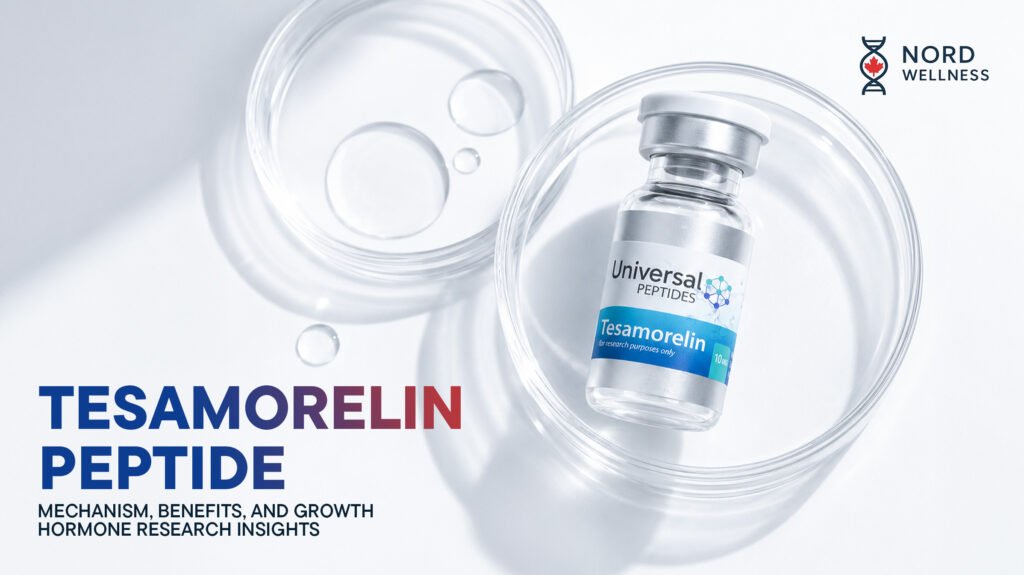
May
Tesamorelin Peptide is one of the most studied synthetic growth hormone-releasing hormone analogs in peptide research. Unlike direct growth hormone administration, researchers design Tesamorelin to stimulate the body’s own growth hormone signaling pathway through the pituitary gland.
In research settings, Tesamorelin is commonly discussed for its relationship with growth hormone release, IGF-1 activity, metabolic regulation, body composition studies, and peptide stability. Because of its specific mechanism, researchers often use it as a reference compound when studying the broader category of GHRH-based peptides.
This article explains what Tesamorelin Peptide is, how it works, why it matters in growth hormone research, and what researchers should know about its structure, storage, and handling.
What Is Tesamorelin Peptide?
Tesamorelin Peptide is a synthetic analog of human growth hormone-releasing hormone, also called GHRH or GRF. GHRH is a naturally occurring hypothalamic peptide that signals the pituitary gland to release growth hormone.
Tesamorelin is based on the 44-amino-acid sequence of human growth hormone-releasing factor, but it includes a modification at the N-terminal region. This modification helps improve stability compared with native GHRH. According to prescribing information, Tesamorelin is composed of the full 44-amino-acid human GRF sequence with a hexenoyl moiety attached to the N-terminal tyrosine residue.
In approved pharmaceutical contexts, clinicians have used Tesamorelin under the brand name Egrifta for specific medical indications related to excess visceral abdominal fat in adults with HIV-associated lipodystrophy. However, in a research peptide context, discussions usually focus on its mechanism, receptor activity, GH/IGF-1 signaling, and metabolic research models rather than clinical use claims. Health Canada’s product information also notes that Egrifta was not intended for general weight loss management.
👉 Explore Tesamorelin Peptide for research purposes at: Tesamorelin Peptide
Tesamorelin as a GHRH Analog
Tesamorelin belongs to a class of peptides known as GHRH analogs. These compounds are designed to mimic the activity of endogenous growth hormone-releasing hormone.
Natural GHRH is released by the hypothalamus and binds to GHRH receptors in the anterior pituitary gland. This receptor activation stimulates the synthesis and pulsatile release of growth hormone. Tesamorelin follows this same general pathway, making it different from compounds that supply growth hormone directly.
The key distinction is:
| Category | Main Function |
|---|---|
| Growth hormone | Acts directly as the hormone |
| GHRH / GHRH analogs | Stimulate the pituitary gland to release endogenous growth hormone |
| Tesamorelin peptide | Synthetic GHRH analog designed to support GH release through receptor signaling |
This makes Tesamorelin valuable in research because it allows scientists to study upstream growth hormone signaling rather than only downstream effects.
How Tesamorelin Affects Growth Hormone Signaling
Tesamorelin Peptide works by interacting with the GHRH receptor on pituitary somatotroph cells. Once activated, this receptor triggers intracellular signaling pathways that lead to the release of endogenous growth hormone.
The general pathway can be understood as:
- Tesamorelin binds to GHRH receptors in the anterior pituitary.
- GHRH receptor activation stimulates intracellular signaling.
- The pituitary releases growth hormone.
- Growth hormone influences the liver and other tissues.
- IGF-1 production increases as part of the GH/IGF-1 axis.
This GH/IGF-1 axis is central to many research areas, including metabolism, cellular growth signaling, protein turnover, tissue repair models, and body composition studies.
Importantly, Tesamorelin does not simply act as growth hormone itself. It acts as a releasing factor analog, meaning its effect depends on the responsiveness of the pituitary gland and the broader endocrine feedback system. FDA labeling describes Tesamorelin as a growth hormone-releasing factor analog that stimulates growth hormone production.
Because Tesamorelin can increase IGF-1, research discussions often include careful attention to endocrine feedback, receptor sensitivity, and long-term signaling considerations.
Common Research Applications of Tesamorelin
In research peptide discussions, researchers most often explore Tesamorelin peptide in relation to growth hormone signaling and metabolic regulation. The following areas are commonly associated with Tesamorelin research:
1. Growth Hormone Axis Research
Tesamorelin is frequently studied as a tool for understanding the GH/IGF-1 axis. Since it stimulates endogenous GH release, researchers can examine how upstream GHRH receptor activation influences downstream endocrine markers.
2. IGF-1 Response Studies
Because growth hormone can stimulate IGF-1 production, researchers often discuss Tesamorelin in studies that evaluate changes in IGF-1. This makes it useful for exploring endocrine response patterns, feedback loops, and metabolic signaling.
3. Body Composition Research
Tesamorelin has been clinically studied in relation to visceral adipose tissue in HIV-associated lipodystrophy. In Canada, the approved product monograph describes Egrifta as indicated for excess visceral adipose tissue in treatment-experienced adult HIV-infected patients with lipodystrophy, while also stating that it is not indicated for weight loss management.
For research content, this distinction is important: Tesamorelin is not simply a “weight loss peptide.” Its relevance is more accurately tied to growth hormone-mediated metabolic signaling and visceral adiposity research.
4. Metabolic Function Studies
The GH/IGF-1 axis plays a role in lipid metabolism, glucose handling, protein synthesis, and cellular energy regulation. Tesamorelin research may therefore examine how GHRH receptor activation influences metabolic markers in controlled experimental models.
5. Comparative Peptide Research
Tesamorelin is also useful as a reference compound when comparing GHRH analogs, growth hormone secretagogues, and other peptides that influence endocrine signaling.

Tesamorelin Structure and Peptide Characteristics
PubChem lists Tesamorelin as a large synthetic peptide with the molecular formula C221H366N72O67S.
Its structure is based on human GHRH but includes an N-terminal modification. This modification is important because native GHRH is rapidly degraded in circulation. By modifying the peptide structure, Tesamorelin demonstrates improved resistance to enzymatic breakdown compared with unmodified GHRH.
Key peptide characteristics include:
| Feature | Description |
|---|---|
| Peptide class | GHRH analog |
| Sequence basis | 44-amino-acid human growth hormone-releasing factor |
| Modification | N-terminal hexenoyl group |
| Primary pathway | GHRH receptor activation |
| Main signaling axis | Growth hormone / IGF-1 axis |
| Research relevance | Endocrine, metabolic, body composition, and GH signaling studies |
These structural features help explain why researchers often describe Tesamorelin as more stable and research-relevant than native GHRH.
Storage, Stability, and Research Considerations
Like many research peptides, Tesamorelin is sensitive to environmental conditions. Temperature, light exposure, moisture, and repeated freeze-thaw cycles can affect peptide stability.
General research storage considerations include:
| Form | Common Research Storage Consideration |
|---|---|
| Lyophilized powder | Store in a cool, dry, light-protected environment |
| Reconstituted peptide | More sensitive; typically requires careful short-term handling |
| Exposure risk | Heat, light, moisture, shaking, and contamination |
| Best practice | Follow supplier COA, storage label, and lab protocol |
Pharmaceutical formulations can have different storage and reconstitution instructions depending on the product version. For example, FDA information for Egrifta SV states that researchers should use the reconstituted solution immediately, discard it if not used right away, and avoid freezing or refrigerating it after reconstitution.
In research settings, maintaining consistency is the most important principle: researchers should follow validated lab protocols, supplier documentation, and any available certificate of analysis when handling peptides.
Researchers should also pay attention to:
- Batch-specific documentation
- Purity testing
- COA availability
- Reconstitution solvent compatibility
- Sterility considerations
- Storage temperature requirements
- Protection from light and moisture
FAQ – Tesamorelin Peptide
What is Tesamorelin peptide?
Tesamorelin Peptide is a synthetic growth hormone-releasing hormone analog. Researchers design it to activate GHRH receptors in the pituitary gland, leading to endogenous growth hormone release.
Is Tesamorelin the same as growth hormone?
No. Tesamorelin is not growth hormone. It is a GHRH analog, meaning it stimulates the pituitary gland to release growth hormone through receptor-mediated signaling.
How does Tesamorelin work?
Tesamorelin works by binding to GHRH receptors in the anterior pituitary. This stimulates growth hormone release, which can then influence IGF-1 production and related metabolic signaling pathways.
Why is Tesamorelin important in peptide research?
Tesamorelin is important because it helps researchers study the GH/IGF-1 axis, endocrine feedback, metabolic signaling, and body composition-related mechanisms through upstream growth hormone stimulation.
Is Tesamorelin used for weight loss?
Tesamorelin should not be described simply as a weight loss compound. Approved product information has specifically stated that Egrifta is not indicated for weight loss management. Researchers more accurately connect its relevance to studies of visceral adipose tissue, growth hormone signaling, and metabolic pathways.
What is the difference between Tesamorelin and GHRH?
GHRH is the natural hormone produced by the hypothalamus. Tesamorelin is a synthetic analog based on the GHRH sequence, with structural modification designed to improve stability.
Does Tesamorelin affect IGF-1?
Yes. Because Tesamorelin stimulates growth hormone release, it can also influence IGF-1 production as part of the GH/IGF-1 axis. Researchers commonly discuss IGF-1 response in Tesamorelin studies for this reason.
How should Tesamorelin peptide be stored?
Storage depends on the form and supplier instructions.In general, researchers should protect lyophilized peptides from heat, light, and moisture. They should also handle reconstituted peptides more carefully, following lab protocols and product-specific guidance.
Is Tesamorelin suitable for human use in research peptide form?
Accordingly, research peptide products are typically intended for laboratory use only and are not intended for human consumption. Any medical use of Tesamorelin belongs under regulated healthcare guidance and approved pharmaceutical contexts.
👉 SEE MORE:
- Tesamorelin Research Peptide: Applications, Stability & Lab Use
- Tesamorelin and Growth Hormone: Effects on GH Release and Regulation
- How Tesamorelin Works: Growth Hormone and Endocrine Function Explained
- Tesamorelin Benefits: Growth Hormone, Metabolism & Research Insights
- Tesamorelin Mechanism Explained: GHRH Pathways and Hormone Signaling
Final Thoughts
Tesamorelin Peptide is best understood as a synthetic GHRH analog that supports research into growth hormone release, IGF-1 signaling, metabolic regulation, and endocrine pathway activity. Its value in peptide research comes from its upstream mechanism: rather than replacing growth hormone directly, it activates the body’s own growth hormone-releasing pathway through the pituitary gland.
For researchers, Tesamorelin offers a clear example of how structural peptide modification can influence stability, receptor activity, and endocrine signaling outcomes. When studying Tesamorelin, we must emphasize accuracy: we should discuss it as a growth hormone-releasing factor analog, not simply as a general weight loss peptide or a direct hormone replacement compound.
Disclaimer
This content is provided by Nord Wellness for educational and research purposes only. Tesamorelin Peptide is not approved for the diagnosis, treatment, cure, or prevention of any disease.


Really informative article with a clear explanation of how Tesamorelin interacts with growth hormone pathways. I liked that the post focused on research insights and metabolic function instead of exaggerated claims. The connection between recovery and hormone regulation was especially interesting.
Good overview of Tesamorelin and its role in growth hormone research. A lot of peptide content online feels too simplified, so this was much more balanced and easier to trust. Curious if future studies will explore broader applications related to metabolism and recovery.
I appreciate how the article explains complex peptide mechanisms in a way that’s still easy to follow. The section about IGF-1 and recovery pathways made the science side much more understandable. It definitely feels like research-based wellness topics are becoming more popular in Canada lately.
Pingback: Tesamorelin Benefits: Growth Hormone, Metabolism & Research Insights - nordwellness.ca
Pingback: Tesamorelin Mechanism Explained: GHRH Pathways and Hormone Signaling - nordwellness.ca
Pingback: How Tesamorelin Works: Growth Hormone and Endocrine Function Explained - nordwellness.ca
Pingback: Tesamorelin and Growth Hormone: Effects on GH Release and Regulation - nordwellness.ca
Pingback: Tesamorelin Research Peptide: Applications, Stability & Lab Use - nordwellness.ca
Pingback: Peptide for Visceral Fat Reduction: Need Help Reducing Stubborn Visceral Fat? Discover Tesamorelin - nordwellness.ca