

Cognitive & Sleep Support, DSIP, Peptides
Understanding the DSIP Mechanism of Action in Sleep and Neurohormonal Balance
Summarize the article with:
 ChatGPT
 Claude
 Perplexity
 Google AI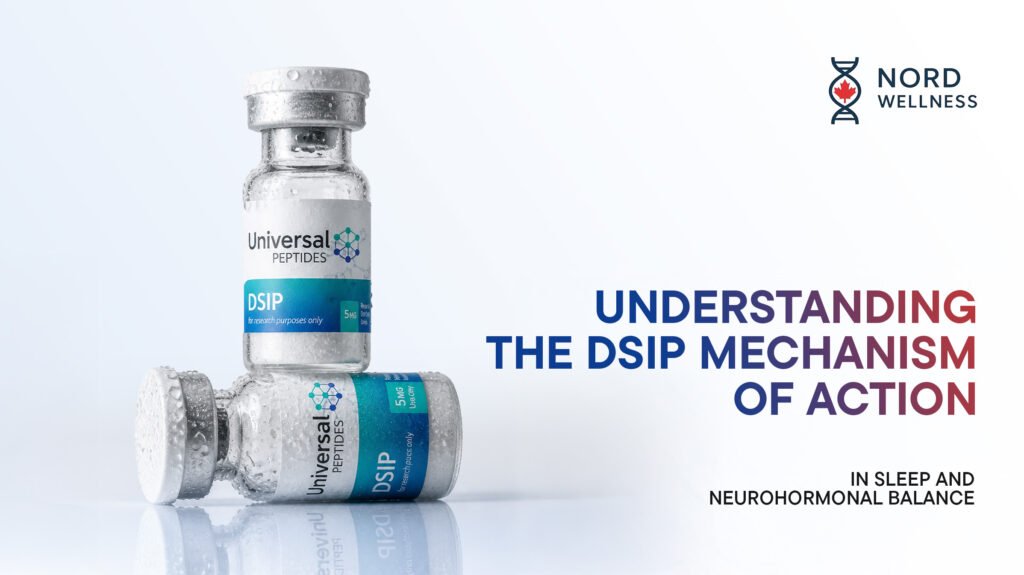
May
Sleep regulation is not controlled by a single pathway—it is the result of complex interactions between the nervous system, endocrine signaling, and circadian rhythms. In peptide research, scientists are increasingly interested in compounds like DSIP mechanism that may influence these systems in a coordinated way rather than targeting a single receptor.
One such compound is Delta Sleep-Inducing Peptide (DSIP). Unlike many neuroactive substances with clearly defined receptor targets, DSIP is studied for its multi-system regulatory effects, particularly in sleep architecture, stress response, and neurohormonal balance.
Understanding the DSIP mechanism of action requires looking beyond traditional models of receptor binding and instead examining how this peptide may interact with broader physiological networks. Explore more science-backed wellness insights and advanced peptide research at Nord Wellness.
What Is the Mechanism of DSIP?
The exact mechanism of DSIP is not fully established, but several key hypotheses have emerged from experimental research.
DSIP is believed to function as a modulatory neuropeptide, meaning it may help regulate biological processes rather than directly triggering them.
Proposed mechanisms include:
- Modulation of neurotransmitter systems (GABA, serotonin, dopamine)
- Interaction with hypothalamic regulation of circadian rhythms
- Influence on neuroendocrine signaling pathways
- Stabilization of stress-related hormonal responses
Unlike many peptides, DSIP does not yet have a clearly identified receptor, which suggests its effects may be indirect and context-dependent.
👉 Explore high-quality DSIP peptides for research purposes
How DSIP Interacts with the Hypothalamus and Pituitary Gland
The hypothalamus and pituitary gland form the core of the body’s neuroendocrine control system.
Research suggests DSIP may interact with this axis by:
- Influencing hypothalamic signaling related to sleep and circadian timing
- Modulating pituitary hormone release patterns
- Supporting communication between neural and hormonal systems
The hypothalamus regulates key processes such as sleep-wake cycles, temperature, and hormone release. By acting at this level, DSIP may contribute to broader physiological balance.
This interaction is particularly relevant in the context of the hypothalamic-pituitary-adrenal (HPA) axis, which governs stress responses.

DSIP and Neurohormone Regulation
DSIP has been studied for its potential role in regulating neurohormones—chemical messengers that link the nervous system with endocrine function.
Key areas of interest include:
- Cortisol regulation under stress conditions
- ACTH (adrenocorticotropic hormone) modulation
- Prolactin and other pituitary hormones
- Circadian rhythm–linked hormone release patterns
Because these hormones are closely tied to sleep cycles, DSIP may influence neurohormonal balance and indirectly affect sleep quality and recovery. Rather than increasing or decreasing specific hormones directly, DSIP may help stabilize their natural rhythms.
Role of DSIP in Melatonin and Growth Hormone Release
Melatonin and growth hormone (GH) are two critical components of sleep-related physiology.
- Melatonin regulates the sleep-wake cycle and signals the body when it is time to sleep.
- Growth hormone is primarily released during deep sleep and plays a key role in recovery and tissue repair.
Research suggests DSIP may:
- Support melatonin rhythm stability through hypothalamic interaction
- Influence growth hormone release indirectly by enhancing deep sleep phases
- Align hormonal release with natural circadian cycles
Because these processes are interconnected, DSIP may affect one pathway and, in turn, influence others within the sleep-recovery system.
How DSIP Stabilizes Neuronal Activity
Neuronal stability is essential for maintaining consistent sleep patterns and preventing disruptions.
DSIP has been studied for its potential ability to:
- Reduce excessive neuronal excitability
- Support inhibitory neurotransmission (e.g., GABA-related pathways)
- Improve balance between excitatory and inhibitory signals
- Protect neurons under stress conditions (neuroprotective hypothesis)
This stabilizing effect may help create conditions that are more favorable for entering and maintaining deep sleep.
Rather than suppressing brain activity, DSIP may help maintain functional equilibrium in neural networks.
DSIP and Stress-Related Peptide Modulation
Stress has a direct impact on sleep quality, primarily through activation of the HPA axis. DSIP is believed to play a role in modulating stress-related peptides and hormones, including:
- Corticotropin-releasing hormone (CRH)
- ACTH
- Cortisol
Experimental findings suggest DSIP may:
- Reduce stress-induced hormonal spikes
- Improve adaptation to stressors
- Limit the negative impact of stress on sleep cycles
This connection between stress modulation and sleep regulation is one of the key reasons DSIP continues to be studied in neuroendocrine research.
Why DSIP Is Unique Among Sleep Peptide
DSIP stands out from other sleep-related compounds due to several distinguishing features:
- No clearly identified receptor pathway
- Functions as a regulatory modulator rather than a direct agonist
- Influences multiple systems simultaneously (sleep, stress, hormones)
- Associated with deep sleep rather than sedation
While many sleep peptides or compounds act through specific receptor binding, DSIP appears to operate through a more complex, system-wide mechanism.
This makes it both challenging to study and potentially valuable for understanding how sleep regulation works at a broader physiological level.
Conclusion
The DSIP mechanism of action reflects the complexity of sleep and neurohormonal regulation. Rather than acting through a single pathway, DSIP appears to influence interconnected systems involving the brain, endocrine signaling, and stress response.
Although research is still ongoing, current evidence suggests DSIP may play a role in stabilizing sleep architecture, supporting hormonal balance, and improving the body’s ability to adapt to stress.
As scientific understanding evolves, researchers continue to use DSIP to gain insights into how sleep can be optimized through biological regulation rather than simple sedation.
To learn more, explore our full article on DSIP Peptide: Benefits, Mechanism, and How Delta Sleep Peptide Works.
FAQ – DSIP Mechanism
1. What is the DSIP mechanism of action?
Researchers believe that DSIP acts as a regulatory neuropeptide, influencing sleep, stress response, and neurohormonal balance. Rather than binding to a single known receptor, it may modulate multiple systems, including neurotransmitters and endocrine signaling pathways.
2. Does DSIP directly induce sleep?
DSIP is not considered a direct sedative. Research suggests it may support natural sleep architecture, particularly deep sleep phases, rather than forcing sleep onset.
3. How does DSIP affect the hypothalamus?
Scientists think that DSIP interacts with the hypothalamus, a key brain region responsible for regulating circadian rhythms and hormone release. This interaction may help coordinate sleep cycles and neuroendocrine signaling.
4. Can DSIP influence hormone levels?
Experimental studies suggest DSIP may help regulate hormones such as cortisol, ACTH, and potentially growth hormone by supporting natural circadian rhythms and deep sleep phases.
5. Does DSIP interact with melatonin?
DSIP may indirectly support melatonin regulation by stabilizing circadian rhythms and hypothalamic signaling, although it does not replace or act identically to melatonin.
6. How does DSIP affect stress response?
DSIP has been studied for its potential to modulate the HPA axis, which controls stress hormones like cortisol. This may help reduce stress-related disruptions in sleep.
7. Why is DSIP considered unique among peptides?
Unlike many peptides with clearly defined receptor targets, DSIP appears to function as a multi-system modulator, influencing sleep, stress, and hormonal balance simultaneously.
8. Is the DSIP mechanism fully understood?
No. While several hypotheses exist, the exact mechanism of DSIP remains under investigation. Its effects may vary depending on biological conditions and research models.
9. Is DSIP approved for medical use?
DSIP is generally classified as a research peptide and is not approved for medical treatment. Most findings are based on experimental and preclinical studies.
Disclaimer
This content is provided by Nord Wellness for educational and research purposes only. DSIP is not approved for the diagnosis, treatment, cure, or prevention of any disease.



Great article—really like how it explains DSIP as a neuromodulator rather than a simple sleep-inducing compound. The way it enhances slow-wave sleep while interacting with multiple neurotransmitter systems makes the mechanism much more nuanced.
I appreciate how the article connects sleep regulation with neurohormonal balance. From my perspective, the modulation of the HPA axis and cortisol response is a key part of how DSIP supports both sleep quality and stress adaptation
Very informative read. What stands out is that DSIP doesn’t act through a single receptor but through multiple pathways, which explains why its effects on sleep, hormones, and stress regulation are still being actively studied.
Pingback: DSIP Peptide: Benefits, Mechanism, and How Delta Sleep Peptide Works - nordwellness.ca