

Immune & Specialized Peptides, Peptides, Thymosin Alpha-1
How Thymosin Alpha-1 Works: Immune Signaling and Cellular Response Explained
Summarize the article with:
 ChatGPT
 Claude
 Perplexity
 Google AI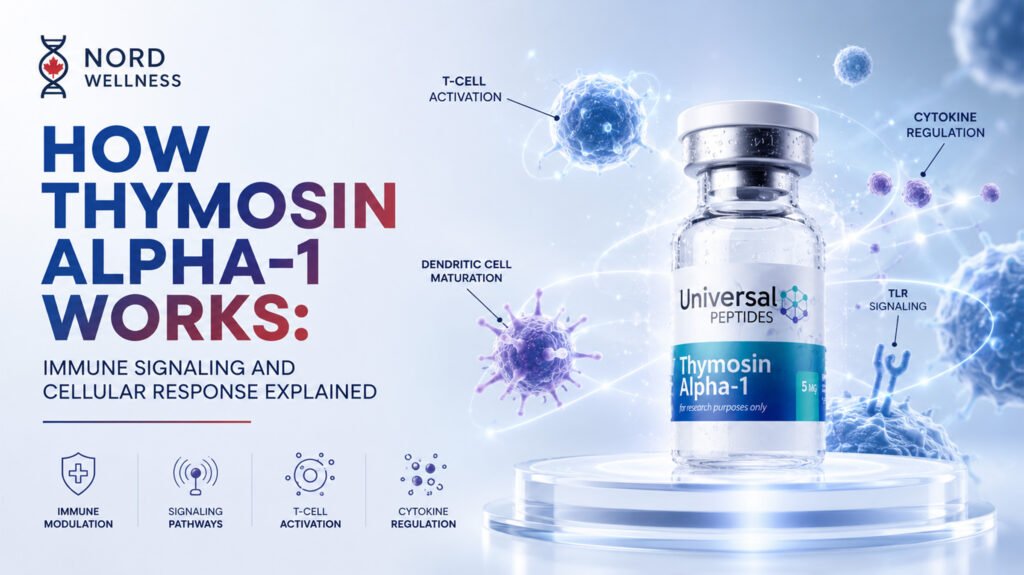
May
Understanding how Thymosin Alpha-1 works requires looking at its role in immune signaling, cellular communication, and peptide-based response regulation. Thymosin Alpha-1, often abbreviated as TA-1 or Tα1, is a 28-amino-acid thymic peptide commonly studied in immune-related research models.
Unlike peptides that are mainly investigated for metabolic signaling, tissue repair pathways, or hormonal regulation, Thymosin Alpha-1 is most often discussed as an immunomodulatory peptide. This means researchers study how it may influence immune response patterns, rather than describing it as a simple immune “booster” or suppressor.
In research literature, TA-1 is frequently associated with T-cell activity, dendritic cell maturation, cytokine signaling, Toll-like receptor pathways, antigen presentation, and innate–adaptive immune communication. These areas help explain why Thymosin Alpha-1 remains an important peptide in immune-focused research.
For more science-based peptide education and responsible research content, visit Nord Wellness to explore peptide mechanisms, research applications, and immune signaling topics.
How Does Thymosin Alpha-1 Work in Research Models?
In research models, Thymosin Alpha-1 is mainly studied for how it may influence immune-cell behavior and signaling coordination. Rather than working through one isolated mechanism, TA-1 appears to be relevant across multiple immune pathways.
Researchers often examine Thymosin Alpha-1 in relation to dendritic cells, T cells, cytokines, chemokines, Toll-like receptors, and immune-response markers. These systems are closely connected because immune function depends on communication between different cell populations.
In simple research terms, TA-1 may be studied through several key mechanisms.
First, it is commonly examined in dendritic cell models. Dendritic cells are antigen-presenting cells that help detect immune signals and communicate them to T cells. Because of this role, they are important in both innate and adaptive immune research.
Second, TA-1 is frequently studied in T-cell response models. T cells are central to adaptive immunity, including CD4+ helper T-cell activity, CD8+ cytotoxic T-cell response, immune memory models, and T-cell exhaustion research.
Third, Thymosin Alpha-1 is studied in cytokine signaling models. Cytokines act as communication molecules between immune cells. Researchers may evaluate whether TA-1 influences cytokines such as IL-2, IFN-related markers, IL-6, TNF-α, IL-10, and other immune-regulatory signals.
Finally, TA-1 is often discussed in relation to Toll-like receptor signaling, especially TLR2 and TLR9 pathways. These receptor systems are important in innate immune recognition and dendritic cell activation.
Together, these research areas suggest that Thymosin Alpha-1 works as a peptide involved in immune coordination, cellular signaling, and biological response modulation.
Effects on Immune System Communication
Immune system communication is one of the most important concepts for understanding how Thymosin Alpha-1 works. The immune system does not function through isolated cells acting alone. Instead, it depends on constant signaling between immune cells, tissue cells, cytokines, receptors, and regulatory networks.
Thymosin Alpha-1 is studied because it may influence several parts of this communication system.
One major area is the communication between dendritic cells and T cells. Dendritic cells help present antigens and provide signals that guide T-cell activation. When dendritic cells mature and function properly, they can support stronger immune coordination in research models.
TA-1 may also be examined in relation to cytokine output. Cytokines help immune cells send messages that control activation, inflammation, regulation, and response timing. In research models, cytokine patterns are often used as measurable indicators of immune communication.
Important cytokines and immune markers commonly discussed in TA-1 research include:
IL-2, which is associated with T-cell activation and growth signaling.
IFN-related markers, which are commonly studied in antiviral and Th1-type immune response models.
IL-6, which plays a role in inflammatory and immune-response signaling.
TNF-α, which is associated with inflammatory activation.
IL-10, which is linked to immune regulation and anti-inflammatory signaling patterns.
The purpose of studying these markers is not to claim that TA-1 simply increases immune function. A more accurate interpretation is that Thymosin Alpha-1 is studied for how it may influence immune communication patterns under specific experimental conditions.
This distinction is important because immune modulation is context-dependent. A peptide may affect one immune model differently from another depending on cell type, inflammatory state, concentration, timing, and study design.
👉 Explore TA-1 Peptide for research purposes at Thymosin Alpha-1 peptide
Role in Experimental Peptide Models
Thymosin Alpha-1 is valuable in experimental peptide models because it provides a focused way to study immune signaling through a defined peptide sequence. As a 28-amino-acid peptide, TA-1 is small enough for targeted mechanism studies while still being biologically relevant to immune-system research.
In experimental models, TA-1 is commonly studied across several immune-related systems.
In infection-related immune models, researchers may examine how TA-1 affects host-response signaling, T-cell function, dendritic cell activity, and cytokine communication. The goal is not to claim that TA-1 directly eliminates pathogens, but to understand how it may influence immune-response coordination.
In vaccine-response models, TA-1 may be studied in relation to antigen presentation, antibody response, T-cell activation, dendritic cell maturation, and immune memory markers. These studies help researchers examine whether immune responsiveness changes under specific experimental conditions.
In inflammation-related models, TA-1 may be evaluated through cytokine patterns, inflammatory mediators, immune-cell activation, and regulatory signaling markers. Because inflammation and immune signaling are closely connected, TA-1 is often discussed in both areas.
In cancer-immunology research, TA-1 may be studied for its relationship with immune surveillance, T-cell activity, dendritic cell function, cytokine networks, and tumor microenvironment signaling. This does not mean TA-1 directly targets cancer cells. The research focus is more often on immune communication and response regulation.
These experimental peptide models help researchers explore how Thymosin Alpha-1 interacts with complex immune systems, rather than reducing its role to a single pathway.
TA-1 and Cellular Response Mechanisms
Cellular response mechanisms describe how cells react when exposed to a biological signal. In the case of Thymosin Alpha-1, researchers are especially interested in how immune cells respond to TA-1 under different experimental conditions.
The most commonly studied cellular response areas include dendritic cell activity, T-cell signaling, cytokine release, receptor-associated signaling, and innate–adaptive immune coordination.
Dendritic Cell Response
Dendritic cells are important because they connect early immune recognition with adaptive immune activation. In TA-1 research, dendritic cells may be evaluated for maturation markers, antigen presentation activity, cytokine production, and Toll-like receptor-related signaling.
If dendritic cell function changes, downstream T-cell response may also change. This makes dendritic cells a central part of understanding how Thymosin Alpha-1 works in immune models.
T-Cell Response
T cells are another major area of TA-1 research. Since Thymosin Alpha-1 is associated with thymic peptide biology, its relationship with T-cell activity is especially important.
Researchers may study TA-1 in relation to T-cell maturation, activation, CD4+ and CD8+ response, T-cell exhaustion, cytokine output, and adaptive immune function. These models help explain why TA-1 is often discussed in immune-compromised, chronic immune stress, vaccine-response, and infection-related research contexts.
Cytokine Response
Cytokines are often measured because they provide insight into immune-cell communication. When researchers study TA-1, they may evaluate whether cytokine expression patterns shift under experimental conditions.
The key point is that cytokine changes must be interpreted carefully. A single cytokine increase or decrease does not fully explain TA-1’s mechanism. Instead, researchers usually examine broader signaling patterns across multiple markers.
Receptor-Associated Signaling
Thymosin Alpha-1 is commonly discussed in relation to Toll-like receptor pathways, especially TLR2 and TLR9. These receptors help immune cells recognize signals and initiate downstream responses.
Because TLR signaling can affect dendritic cell activity, cytokine production, and T-cell communication, it is one of the important research areas connected to TA-1’s cellular response mechanisms.
👉 Explore TA-1 Peptide for research purposes at Thymosin Alpha-1 peptide
What Makes Thymosin Alpha-1 Unique?
Thymosin Alpha-1 is unique because it sits at the intersection of peptide signaling, immune regulation, and cellular communication research. Many peptides are studied for one dominant pathway, but TA-1 is often discussed across several immune systems at once.
One key feature is its thymic origin. The thymus is strongly connected to T-cell development, which gives TA-1 a natural research connection to adaptive immunity.
Another important feature is its immunomodulatory profile. TA-1 is not best described as simply increasing immune activity. Instead, it is studied for how it may influence immune response patterns, especially in models where immune signaling is altered, weakened, excessive, or dysregulated.
TA-1 is also unique because it is studied across both innate and adaptive immunity. Innate immune research may involve dendritic cells, macrophages, natural killer cells, and Toll-like receptor pathways. Adaptive immune research may involve T-cell activation, CD4+ and CD8+ response, antibody-related signaling, and immune memory models.
This makes Thymosin Alpha-1 valuable for research questions such as:
- How do immune cells communicate during stress or immune challenge?
- How do dendritic cells influence T-cell activation?
- How do cytokine networks change under peptide exposure?
- How do innate immune pathways connect with adaptive immune response?
- How does peptide stability affect immune signaling outcomes?
These questions help explain why Thymosin Alpha-1 remains a significant peptide in immune-focused research.
Research Considerations for Studying How TA-1 Works
Although Thymosin Alpha-1 has been widely studied, responsible interpretation is still necessary. Immune signaling is complex, and results may vary depending on study design, cell type, concentration, timing, and biological context.
Researchers should consider several important factors.
Cell type matters. TA-1 may behave differently in dendritic cells, T cells, macrophages, epithelial cells, or mixed immune-cell systems.
Immune status matters. A model involving immune suppression, chronic immune stress, inflammation, infection-related signaling, or baseline immune function may produce different results.
Concentration and timing matter. Peptide exposure levels and duration can influence observed outcomes.
Peptide quality matters. Purity, identity verification, storage, reconstitution, and stability can affect experimental reliability.
Endpoint selection matters. Measuring only one cytokine or one receptor pathway may not fully capture TA-1’s broader immune signaling role.
Because of these variables, Thymosin Alpha-1 should be described as a research peptide studied for immune signaling and cellular response, not as a guaranteed treatment or universal immune-enhancing compound.
To learn more about: Thymosin Alpha-1 Peptide: Structure, Immune Signaling, and Research Applications
FAQ – How Thymosin Alpha 1 Works
What is Thymosin Alpha-1?
Thymosin Alpha-1 is a 28-amino-acid thymic peptide studied for immune signaling, T-cell activity, dendritic cell function, cytokine regulation, and innate–adaptive immune communication.
How does Thymosin Alpha-1 work?
Thymosin Alpha-1 is studied for how it may influence immune signaling pathways, dendritic cell maturation, T-cell response, cytokine communication, Toll-like receptor activity, and cellular response mechanisms in research models.
Is Thymosin Alpha-1 an immune booster?
It is more accurate to describe Thymosin Alpha-1 as an immunomodulatory peptide. Research focuses on immune communication and signaling balance, rather than simple immune stimulation.
What immune cells are associated with TA-1 research?
TA-1 is commonly studied in relation to dendritic cells, T cells, macrophages, natural killer cells, and other immune-cell systems involved in innate and adaptive immunity.
Does TA-1 affect T cells?
Yes, TA-1 is often studied in models involving T-cell maturation, T-cell activation, CD4+ and CD8+ response, cytokine output, and adaptive immune signaling.
Does Thymosin Alpha-1 affect cytokines?
Thymosin Alpha-1 is studied in relation to cytokine signaling. Researchers may examine markers such as IL-2, IFN-related signals, IL-6, TNF-α, IL-10, and other immune-regulatory cytokines.
What makes TA-1 different from other peptides?
TA-1 is unique because it is strongly associated with immune signaling rather than one single pathway. It is studied across dendritic cell function, T-cell response, cytokine communication, Toll-like receptor signaling, and innate–adaptive immune coordination.
Is Thymosin Alpha-1 used in research only?
In research-focused peptide content, TA-1 should be discussed as a peptide studied for immune signaling, cellular response, and immune modulation. Regulatory status and approved uses may vary by country and indication.
Final Thoughts
Understanding how Thymosin Alpha-1 works means looking at immune signaling as a network rather than a single pathway. TA-1 is studied for its relationship with dendritic cell function, T-cell response, cytokine communication, Toll-like receptor pathways, and innate–adaptive immune coordination.
Its value in peptide research comes from its ability to help researchers explore how immune cells communicate and respond under different experimental conditions. However, TA-1 should not be described as a simple immune booster or guaranteed therapeutic solution. The most accurate framing is that Thymosin Alpha-1 is a research peptide studied for immune modulation, cellular response, and peptide-based signaling.
Disclaimer
This content is provided by Nord Wellness for educational and research purposes only. Thymosin Alpha-1 peptide is not approved for the diagnosis, treatment, cure, or prevention of any disease.



Really enjoyed how this article explained Thymosin Alpha-1’s role in immune signaling and cellular response in a way that was both scientific and easy to understand. A lot of peptide content online feels either too simplified or too promotional, but this piece stayed informative and balanced throughout. I’d definitely be interested in reading more about how TA1 interacts with other immune-related peptides in research settings.
This was a very well-written breakdown of a complex topic. I appreciated the focus on cellular signaling pathways and immune communication instead of exaggerated claims. The article made the science behind Thymosin Alpha-1 much more approachable for readers trying to understand current peptide research.
Great article overall. The explanation of immune response signaling and peptide interaction mechanisms was detailed enough to feel credible while still being easy to follow. It’s refreshing to see research-focused peptide content presented in such a clear and professional way.
Pingback: Thymosin Alpha-1 Peptide: Structure, Immune Signaling, and Research Applications - nordwellness.ca