

Immune & Specialized Peptides, Peptides, VIP
VIP Nasal Spray: Intranasal Delivery and Research Considerations
Summarize the article with:
 ChatGPT
 Claude
 Perplexity
 Google AI
Jun
VIP nasal spray refers to an intranasal research formulation of Vasoactive Intestinal Peptide, a 28-amino-acid neuropeptide studied for its role in cellular signaling, vascular regulation, smooth muscle activity, immune communication, and neuroendocrine pathways. In research contexts, intranasal delivery is often discussed because the nasal cavity provides a unique interface between local mucosal tissue, systemic circulation, and potential nose-to-brain transport pathways.
For peptide researchers, the key question is not simply what VIP is, but how intranasal delivery may influence absorption, stability, receptor interaction, and experimental outcomes. This article explores VIP nasal spray from a research-only perspective, focusing on intranasal delivery mechanisms, bioavailability considerations, experimental use, and safety limitations.
NordWellness provides educational peptide resources for researchers and readers who want to better understand peptide mechanisms, delivery methods, and laboratory considerations.
What Is VIP Nasal Spray in Research Context?
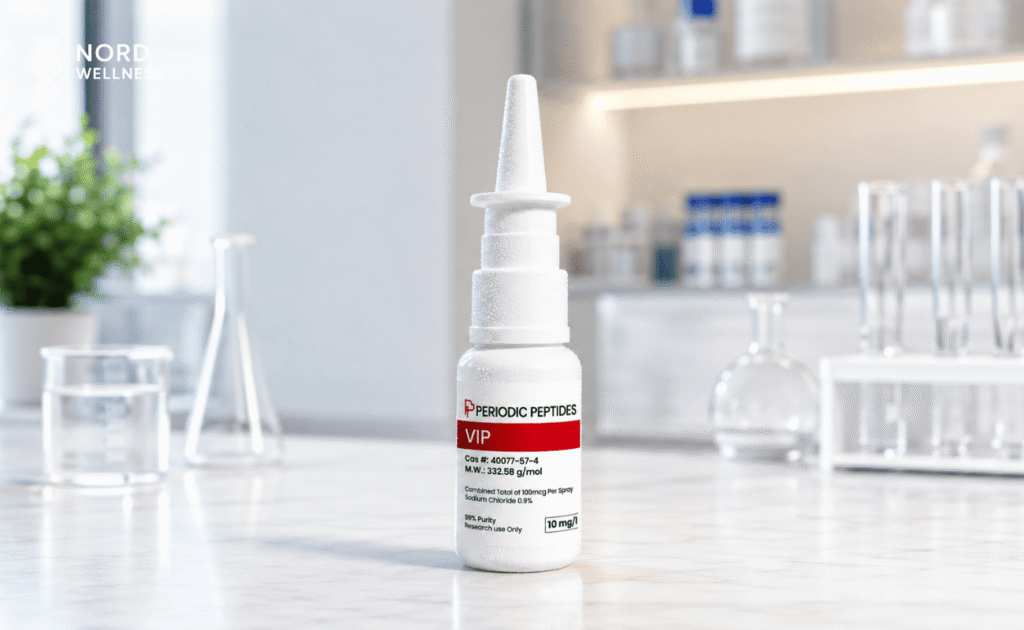
In research terminology, VIP nasal spray usually refers to a liquid intranasal formulation designed to deliver Vasoactive Intestinal Peptide through the nasal route. Unlike oral administration, which exposes peptides to digestive enzymes and first-pass metabolism, intranasal delivery introduces the compound directly to the nasal mucosa.
VIP itself is a naturally occurring neuropeptide that primarily acts through VPAC1 and VPAC2 receptors, both of which belong to the G protein-coupled receptor family. These receptors are involved in intracellular signaling pathways such as adenylyl cyclase activation and cyclic AMP, or cAMP, production. VIP has been studied in respiratory, vascular, immune, gastrointestinal, and nervous system models due to its broad receptor distribution and multi-system signaling profile.
In a research setting, a nasal spray formulation may be studied for several reasons:
- To evaluate intranasal peptide absorption
- To examine nasal mucosa interaction
- To compare local, systemic, and central nervous system exposure
- To study delivery efficiency compared with other routes
- To explore formulation variables such as pH, osmolarity, concentration, and stability
It is important to distinguish research context from therapeutic claims. VIP nasal spray should not be described as a treatment unless discussed within properly approved medical or clinical frameworks.
Intranasal Peptide Delivery Mechanisms
Intranasal delivery is studied because the nasal cavity has several anatomical and physiological features that may support rapid absorption. The nasal mucosa contains a rich vascular network, a relatively large absorptive surface area, and direct connections with olfactory and trigeminal neural pathways.
For peptide delivery, researchers generally discuss three major routes:
| Delivery Pathway | Research Explanation |
|---|---|
| Local nasal action | The peptide interacts with nasal mucosa or local receptors |
| Systemic absorption | The peptide crosses the nasal mucosa and enters blood circulation |
| Nose-to-brain transport | The peptide may access central nervous system pathways through olfactory or trigeminal routes |
The nose-to-brain pathway is especially relevant in peptide and neuropeptide research. Reviews on intranasal delivery describe potential transport from the nasal cavity toward the central nervous system through olfactory nerves, trigeminal nerves, cerebrospinal fluid, vascular routes, and lymphatic pathways.
For VIP specifically, animal research has examined nasal administration as a possible route for brain delivery. One rat study investigated VIP stability in nasal wash solutions and evaluated formulation factors such as pH, osmolarity, and absorption enhancer concentration in relation to brain uptake.
This does not mean intranasal VIP automatically produces predictable systemic or central effects in all models. Instead, it shows why formulation design and experimental conditions are critical when studying VIP nasal spray.
Absorption and Bioavailability in Research Models
Bioavailability refers to how much of a compound reaches the target biological compartment in an active or measurable form. For peptides, bioavailability is often a major challenge because peptides can be unstable, enzymatically degraded, or poorly absorbed across biological membranes.
With intranasal peptide delivery, absorption may be influenced by several factors:
| Factor | Why It Matters |
|---|---|
| Molecular size | Larger peptides may cross mucosal barriers less efficiently |
| Peptide stability | Enzymes in nasal secretions may degrade peptides |
| Formulation pH | pH can affect peptide stability and mucosal tolerance |
| Osmolarity | Hypo- or iso-osmolar formulations may influence uptake |
| Absorption enhancers | Some compounds may increase mucosal permeability |
| Spray volume | Excess liquid may drain into the throat instead of remaining in the nasal cavity |
| Mucociliary clearance | The nasal cavity naturally clears substances over time |
| Device performance | Droplet size and spray pattern affect deposition |
VIP nasal spray research must account for these variables because formulation differences can change experimental results. A formulation that performs well in one model may not behave the same way in another.
Research into intranasal VIP has examined parameters such as VIP stability in nasal wash solutions, formulation pH, osmolarity, and the use of lauroylcarnitine as an absorption enhancer. These variables were studied because they may influence peptide uptake and tissue distribution after nasal administration.
For this reason, “VIP nasal spray bioavailability” should not be discussed as a fixed number unless a specific formulation, model, method, dose, and measurement endpoint are clearly defined.
VIP Delivery Methods and Experimental Use
VIP can be studied using different delivery methods depending on the purpose of the experiment. Each route has advantages and limitations.
Intranasal Delivery
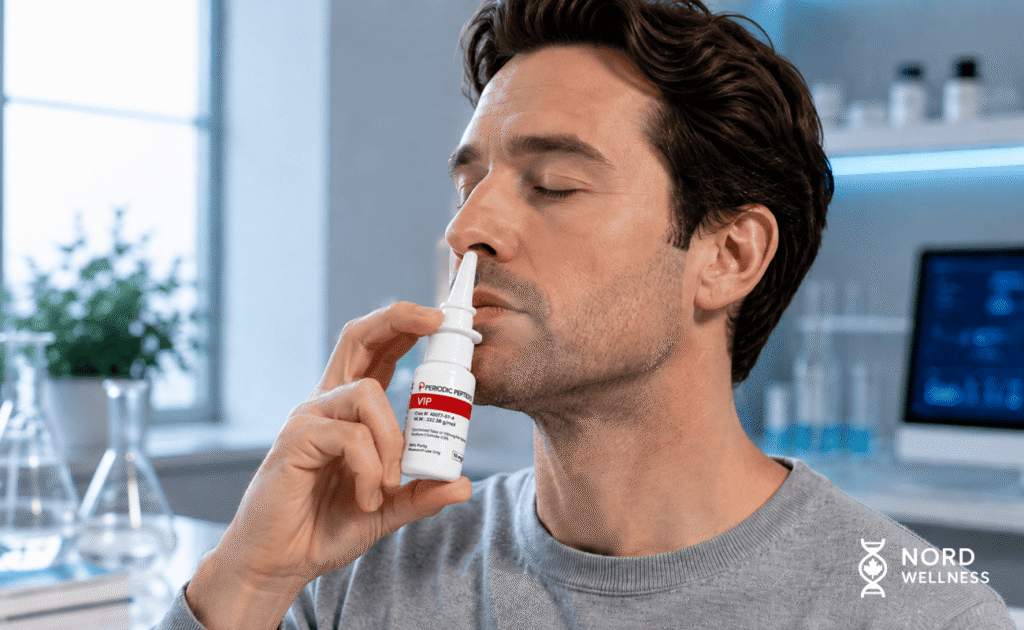
Intranasal VIP delivery is studied for nasal mucosal absorption, systemic exposure, and potential nose-to-brain transport. It may be useful in experiments where researchers want to avoid oral degradation or reduce invasiveness compared with injection-based approaches.
Inhaled or Pulmonary Delivery
Because researchers have studied VIP in respiratory models, they have also explored inhaled VIP agonists and pulmonary delivery approaches in relation to airway biology and pulmonary signaling. Reviews have discussed VIP’s role in respiratory homeostasis and the potential relevance of VIP-related compounds in respiratory research.
Injectable Delivery
Researchers may use injection-based methods, such as subcutaneous, intravenous, or intraperitoneal administration, in laboratory models when they need more controlled systemic exposure. However, injections may not reflect the same absorption pattern as nasal administration.
In Vitro Application
In cell culture studies, researchers may add VIP directly to experimental media to examine receptor activation, cAMP signaling, cytokine-related changes, smooth muscle signaling, or other cellular responses. This approach allows researchers to focus on cellular mechanisms without delivery-route variables.
Ex Vivo Tissue Models
Researchers may use tissue bath or isolated tissue studies to examine VIP effects on smooth muscle tone, vascular relaxation, or secretory responses. These models help researchers study tissue-level effects under controlled conditions.
Nasal Spray vs Other Delivery Forms
In research context, nasal spray delivery is not automatically “better” than other forms. It is simply different. The best delivery method depends on the research question.
| Delivery Form | Research Advantages | Research Limitations |
|---|---|---|
| Nasal spray | Non-invasive, avoids digestive breakdown, may support nasal/systemic/CNS exposure studies | Variable absorption, mucociliary clearance, formulation-sensitive |
| Injection | More controlled systemic exposure, useful for pharmacokinetic models | Invasive, may not match mucosal delivery behavior |
| Oral delivery | Easy administration in theory | Peptides are often degraded in the gastrointestinal tract |
| Inhaled delivery | Relevant to respiratory models | Requires aerosol control and pulmonary deposition assessment |
| Cell culture application | Direct receptor and pathway study | Does not reflect whole-body delivery or metabolism |
| Ex vivo tissue models | Useful for smooth muscle or vascular response studies | Limited translation to full organism physiology |
For VIP nasal spray research, the main value lies in studying how the nasal route affects peptide exposure, absorption, and biological signaling. However, this route also introduces variability. Nasal anatomy, mucosal condition, spray technique, formulation chemistry, and clearance mechanisms can all affect results.
This is why research conclusions should always specify the delivery method. VIP administered intranasally, intravenously, by inhalation, or directly into cell culture may produce different observations because the exposure pattern is different.
Safety and Research Limitations
VIP is biologically active, which means safety and interpretation require careful attention in research settings. Because VIP interacts with VPAC receptors and influences signaling pathways related to vascular tone, smooth muscle activity, immune communication, and secretion, researchers must avoid assuming that all effects are predictable or uniform.
Important research limitations include:
- Model dependency: Findings from animals, cell cultures, or ex vivo tissues may not directly translate to humans.
- Formulation variability: pH, osmolarity, concentration, solvent, and absorption enhancers can influence results.
- Peptide instability: Enzymatic degradation, temperature, light, or repeated freeze-thaw cycles may affect VIP stability.
- Dose sensitivity: VIP signaling may vary depending on concentration and exposure time.
- Route-specific effects: Intranasal delivery may produce different exposure than injection, inhalation, or direct cell application.
- Nasal tolerance: Intranasal formulations may require assessment for irritation, mucosal effects, or local tolerability in appropriate models.
- Regulatory context: Writers should not market or discuss research peptides as approved treatments unless proper regulatory status and clinical evidence support those claims.
Intranasal delivery research also carries toxicology considerations. Reviews on intranasal drug development emphasize that nasal administration can involve both opportunities and safety challenges, including local tissue exposure, formulation effects, and route-specific toxicology evaluation.
For research readers, the most accurate way to interpret VIP nasal spray is as a delivery model for studying peptide absorption and signaling, not as a guaranteed method for achieving specific biological outcomes.
Want to understand VIP beyond intranasal delivery? Read our full guide: VIP Peptide: Function, Mechanism, and Research Applications to explore its function, receptor mechanisms, and broader research applications.
FAQ – Vip Nasal Spray
What is VIP nasal spray?
VIP nasal spray refers to an intranasal research formulation of Vasoactive Intestinal Peptide. It is studied for nasal delivery, absorption, and potential effects on peptide exposure in local, systemic, or central nervous system research models.
Why is VIP studied through intranasal delivery?
VIP is studied through intranasal delivery because the nasal cavity may allow absorption through mucosal tissue and may provide potential pathways toward the central nervous system through olfactory and trigeminal routes.
Does intranasal delivery improve VIP bioavailability?
Intranasal delivery may improve certain exposure patterns compared with routes such as oral delivery, but VIP bioavailability depends on formulation, concentration, pH, osmolarity, nasal clearance, enzymatic degradation, and the research model used.
How does VIP nasal spray work in research models?
In research models, VIP nasal spray delivers VIP to the nasal cavity, where the peptide may interact with local mucosa, enter systemic circulation, or be studied for possible nose-to-brain transport. VIP’s biological activity is mainly linked to VPAC1 and VPAC2 receptor signaling.
Is VIP nasal spray the same as injectable VIP?
No. Nasal spray and injectable VIP differ in delivery route, absorption pattern, tissue exposure, and experimental interpretation. Researchers should not automatically apply findings from one delivery method to another.
What factors affect VIP nasal spray stability?
VIP nasal spray stability may be affected by temperature, light, pH, solvent composition, moisture, enzymatic degradation, and storage conditions. Reconstituted peptide solutions are generally more stability-sensitive than lyophilized peptides.
Is VIP nasal spray used as a treatment?
This article discusses VIP nasal spray from a research and educational perspective only. It should not be described as a treatment unless referring to properly approved clinical or pharmaceutical contexts.
Final Thoughts
VIP nasal spray is an important topic in peptide research because it combines two complex areas: VIP biology and intranasal delivery science. VIP itself is a multi-system neuropeptide studied for receptor-mediated signaling through VPAC1 and VPAC2 receptors. Intranasal delivery adds another layer of complexity by introducing factors such as nasal mucosal absorption, formulation stability, mucociliary clearance, and potential nose-to-brain transport.
In research models, VIP nasal spray may be useful for studying absorption patterns, delivery efficiency, receptor signaling, and tissue-specific responses. However, outcomes depend heavily on formulation design, experimental model, route-specific variables, and measurement methods.
Disclaimer
This content is provided by Nord Wellness for educational and research purposes only. VIP peptide is not approved for the diagnosis, treatment, cure, or prevention of any disease.


This was a really interesting overview of VIP nasal spray and its potential research applications. I appreciated how the article focused on signaling pathways, immune regulation, and neuropeptide activity instead of making unrealistic claims. The discussion around intranasal delivery and cellular response mechanisms was especially informative.
Great article overall. A lot of content about peptide sprays tends to stay very surface-level, but this piece explained the biological mechanisms and research interest behind VIP in a much more detailed way. I’d be interested in reading more about how VIP nasal delivery compares with other peptide administration methods in research settings.
Really well-written and easy to follow. The explanation of VIP’s role in immune signaling, neurological pathways, and physiological regulation made the topic feel much more approachable. It’s refreshing to see research-focused peptide content presented with this level of clarity and balance.