

Growth Hormone Inducing Peptides, Peptides, Tesamorelin
Looking for the Best Peptide for Belly Fat Loss? Discover Why Tesamorelin Stands Out
Summarize the article with:
 ChatGPT
 Claude
 Perplexity
 Google AI
May
When people search for the best peptide for belly fat loss, they are often looking for a compound that targets stubborn abdominal fat rather than general body weight. In peptide research, this topic is usually connected to visceral fat, growth hormone signaling, metabolic regulation, and body composition studies.
Researchers frequently discuss Tesamorelin in this area because it functions as a synthetic growth hormone-releasing hormone analog, also known as a GHRH analog. It does not act as growth hormone directly. Instead, Tesamorelin stimulates the pituitary gland to release endogenous growth hormone, which can influence downstream IGF-1 signaling and metabolic pathways.
For researchers exploring peptide mechanisms, growth hormone pathways, and body composition-related studies, Nord Wellness provides educational peptide resources and research-focused product information. Visit Nord Wellness
What Makes a Peptide Effective for Belly Fat Loss?
To understand why researchers often discuss Tesamorelin as a candidate in belly fat-related research, it is important to define what “belly fat” means in scientific contexts.
Researchers usually divide belly fat into two categories:
| Type of Fat | Description | Research Relevance |
|---|---|---|
| Subcutaneous fat | Fat stored under the skin | Often associated with appearance and general body composition |
| Visceral fat | Fat stored around internal organs | More closely linked to metabolic research and abdominal fat studies |
Researchers may consider a peptide relevant to belly fat research if it interacts with biological pathways involved in:
- Growth hormone signaling
- Lipid metabolism
- Energy regulation
- Insulin and glucose-related pathways
- Visceral adipose tissue activity
- Body composition markers
- Endocrine feedback systems
However, accuracy matters. A peptide should not be described as “effective for belly fat loss” unless the specific evidence supports that claim. In Tesamorelin’s case, the strongest clinical research is tied to excess visceral abdominal fat in adults with HIV-associated lipodystrophy, not general cosmetic weight loss.
The FDA states in its EGRIFTA WR labeling that the drug is approved to reduce excess abdominal fat in HIV-infected adult patients with lipodystrophy. The agency also emphasizes that EGRIFTA WR is not indicated for weight loss management and has a weight-neutral effect.

Researchers consider Tesamorelin a scientifically important compound in visceral fat research, but they should not frame it as a general weight-loss peptide.
Why Tesamorelin Is Often Discussed for Belly Fat Research
Researchers often discuss Tesamorelin in belly fat research because of its specific relationship with visceral adipose tissue and growth hormone signaling.
Unlike compounds that directly suppress appetite or alter caloric intake, Tesamorelin works through the GHRH pathway. It stimulates the pituitary gland to release endogenous growth hormone, which can then affect downstream metabolic processes.
The basic pathway looks like this:
| Step | Biological Process |
|---|---|
| 1 | Tesamorelin binds to GHRH receptors |
| 2 | The pituitary gland releases growth hormone |
| 3 | Growth hormone influences downstream tissues |
| 4 | IGF-1 activity may increase |
| 5 | Lipid metabolism and visceral fat-related pathways may be studied |
Additionally, Health Canada states in its Summary Basis of Decision that Egrifta demonstrated a favourable benefit-risk profile for treating excess visceral adipose tissue in treatment-experienced adult HIV-infected patients with lipodystrophy.
This is why Tesamorelin stands out in discussions about belly fat-related peptide research. Its relevance is not based on broad weight-loss claims. It is based on a defined research and clinical history involving visceral abdominal fat.
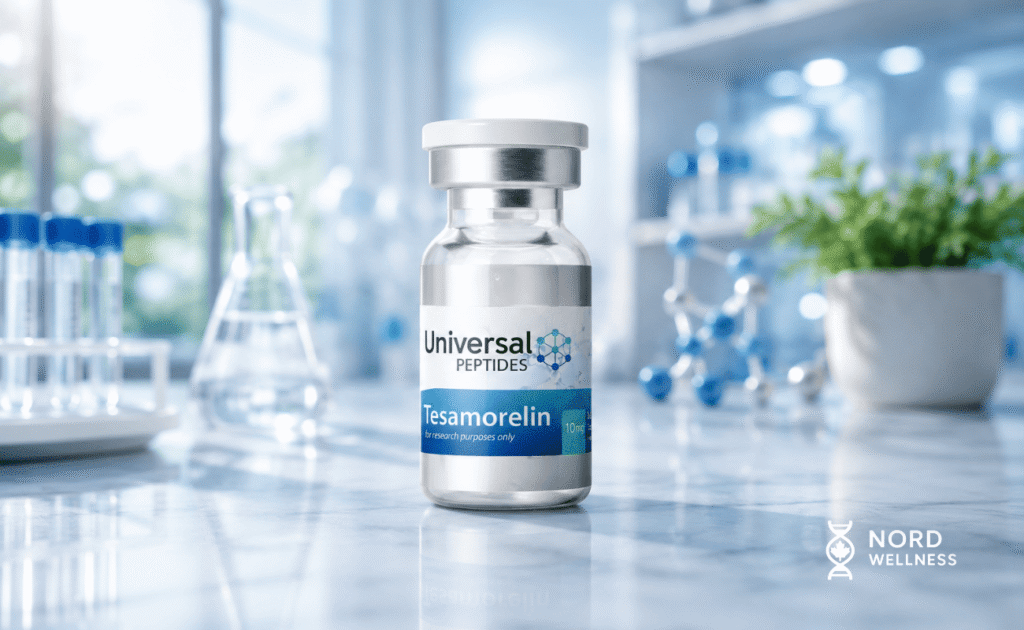
How Tesamorelin Relates to Visceral Fat and Metabolic Research
Researchers define visceral fat as metabolically active tissue stored deep within the abdominal cavity around internal organs. They distinguish it from subcutaneous fat, which sits beneath the skin. Body composition researchers study visceral fat extensively because it is closely linked to metabolic signaling, inflammation markers, lipid regulation, and insulin-related pathways.
Tesamorelin relates to visceral fat research through the GH/IGF-1 axis.
Growth hormone signaling may influence:
- Lipid oxidation
- Fat distribution
- Hepatic lipid metabolism
- Protein turnover
- Lean tissue research
- Glucose-related pathways
- Visceral adipose tissue activity
In clinical research, Tesamorelin has been studied for excess visceral adipose tissue in HIV-associated lipodystrophy. Specifically, a Canadian pharmacoeconomic review describes Tesamorelin as indicated for the treatment of excess visceral adipose tissue in treatment-experienced adult HIV-infected patients with lipodystrophy, confirmed by waist circumference and CT-based VAT measures.
For SEO content, this distinction is important. A more accurate phrase is not “Tesamorelin melts belly fat.” A better research-safe explanation is:
Researchers study Tesamorelin for its role in growth hormone-mediated metabolic regulation and visceral adipose tissue research.
This keeps the content accurate while still addressing the search intent behind “best peptide for belly fat loss.”
Tesamorelin vs Other Peptides for Fat Loss
When people compare peptides for fat loss, they often group many compounds together. But not all peptides work through the same biological pathway.
Tesamorelin is best categorized as a GHRH analog. It works by stimulating endogenous growth hormone release through the growth hormone-releasing hormone receptor pathway.
Researchers study other peptides or peptide-like compounds in fat loss and body composition research for a variety of reasons, including appetite signaling, insulin pathways, tissue repair, inflammation models, and metabolic regulation.
| Peptide Category | Main Research Pathway | How It Differs from Tesamorelin |
|---|---|---|
| GHRH analogs | Stimulate GH release through GHRH receptors | Tesamorelin belongs here |
| GH secretagogues | May stimulate GH through ghrelin-related pathways | Different receptor system |
| GLP-1-related compounds | Appetite, glucose, and insulin-related signaling | Not the same pathway as GHRH |
| Recovery peptides | Tissue repair and inflammation-related models | Not primarily fat-focused |
| Direct growth hormone | Acts as GH itself | Tesamorelin stimulates endogenous GH release instead |
This is why Tesamorelin is unique. It is not simply another “fat loss peptide.” Its research relevance comes from its link to growth hormone release, IGF-1 signaling, and visceral adipose tissue studies.
Compared with many peptides promoted for body composition, Tesamorelin has a more defined clinical research history in relation to abdominal visceral fat. However, approved product information also clearly states that the drug is not intended for general weight loss management, and accurate articles should communicate this distinction clearly.
Who Might Be Interested in Tesamorelin Research?
Tesamorelin research may be of interest to individuals, labs, and educational readers studying the intersection of endocrine signaling and body composition.
Relevant research interests may include:
| Research Interest | Why Tesamorelin Is Relevant |
|---|---|
| Growth hormone research | Tesamorelin stimulates endogenous GH release |
| IGF-1 signaling | GH release can influence downstream IGF-1 |
| Visceral fat studies | Tesamorelin has been studied in excess VAT contexts |
| Metabolic regulation | GH signaling may influence lipid and glucose pathways |
| Endocrine feedback | Tesamorelin interacts with the hypothalamic-pituitary axis |
| Body composition research | Useful for studying abdominal fat distribution mechanisms |
Readers searching for the best peptide for belly fat loss should understand that Tesamorelin research is not the same as a consumer weight-loss recommendation. Instead, the more scientifically accurate focus is on visceral fat research, GH-mediated metabolic signaling, and defined clinical study populations.
For research-focused educational resources, Nord Wellness provides peptide information designed to support informed reading and responsible research review Nord Wellness
Key Safety, Quality, and Research-Use Considerations
Because Tesamorelin affects growth hormone and IGF-1 signaling, safety and research-use considerations are important.
FDA labeling notes that long-term cardiovascular safety has not been established and that Tesamorelin is not indicated for weight loss management. It also highlights considerations related to malignancy risk, glucose intolerance or diabetes, hypersensitivity reactions, fluid retention, and potential increases in IGF-1.
For research settings, important considerations include:
- Use only in controlled research contexts
- Review all available safety and regulatory information
- Avoid consumer-style claims such as “guaranteed belly fat loss”
- Distinguish visceral fat research from general weight loss
- Confirm compound identity and purity before research use
- Review certificate of analysis and third-party testing data
- Follow supplier-specific storage and handling documentation
- Avoid extrapolating HIV lipodystrophy findings to unrelated populations
Quality also matters. Research-grade peptides should ideally include:
| Quality Factor | Why It Matters |
|---|---|
| Certificate of Analysis | Supports batch-specific transparency |
| HPLC purity data | Helps evaluate peptide purity |
| Mass spectrometry | Supports identity confirmation |
| Lot number | Allows traceability |
| Storage guidance | Helps preserve peptide stability |
| Research-use labeling | Clarifies non-clinical intent |
For Tesamorelin specifically, quality and documentation are important because research outcomes may vary if peptide identity, purity, storage, or reconstitution practices are inconsistent.
For deeper research insights, read the full Tesamorelin guide from NordWellness: Tesamorelin Peptide: Mechanism, Benefits, and Growth Hormone Research Insights
FAQ – Best Peptide For Belly Fat Loss
What is the best peptide for belly fat loss?
Researchers often consider Tesamorelin one of the most relevant peptides in belly fat-related studies because of its clinical research history involving visceral abdominal fat. However, they should not describe it as a general weight-loss peptide.
Why is Tesamorelin discussed for belly fat research?
Tesamorelin is discussed because it stimulates endogenous growth hormone release through the GHRH pathway. This can influence IGF-1 signaling and metabolic pathways related to visceral adipose tissue research.
Is Tesamorelin approved for weight loss?
No. The FDA states in its labeling that EGRIFTA WR is not indicated for weight loss management and produces a weight-neutral effect. The agency approves it specifically for reducing excess abdominal fat in HIV-infected adult patients with lipodystrophy.
What type of belly fat is Tesamorelin studied for?
Researchers most closely associate Tesamorelin with visceral adipose tissue research. They define visceral fat as deep abdominal fat stored around internal organs, which differs from the subcutaneous fat located beneath the skin.
How does Tesamorelin work?
Tesamorelin works as a GHRH analog. It binds to growth hormone-releasing hormone receptors in the pituitary gland, stimulating endogenous growth hormone release and downstream IGF-1 signaling.
Is Tesamorelin the same as HGH?
No. Tesamorelin is not HGH. HGH is growth hormone itself, while Tesamorelin stimulates the body’s own growth hormone release pathway.
How is Tesamorelin different from GLP-1 compounds?
Tesamorelin works through the GHRH receptor and growth hormone pathway. GLP-1-related compounds are typically studied for appetite, glucose, and insulin-related signaling. They are different categories with different mechanisms.
Can Tesamorelin research be generalized to all people trying to lose belly fat?
No. Researchers have tied the strongest clinical evidence to specific populations, especially adults with HIV-associated lipodystrophy and excess visceral adipose tissue. They should not broadly generalize these findings to all weight-loss contexts.
Is Tesamorelin for research use only?
Manufacturers and suppliers typically provide research peptide products exclusively for laboratory and educational research purposes. Therefore, they do not market or intend these products for human consumption, diagnosis, treatment, cure, or disease prevention.
Final Thoughts
For readers searching for the best peptide for belly fat loss, Tesamorelin stands out because of its specific connection to growth hormone signaling and visceral abdominal fat research. Its mechanism is based on GHRH receptor activation, endogenous growth hormone release, and downstream IGF-1 activity.
However, scientific accuracy is essential. Researchers should not position Tesamorelin as a general weight-loss solution. They most strongly associate its research relevance with visceral adipose tissue, endocrine signaling, and metabolic pathway studies, particularly in defined clinical contexts such as HIV-associated lipodystrophy.
Disclaimer
This content is provided by Nord Wellness for educational and research purposes only. Tesamorelin Peptide is not approved for the diagnosis, treatment, cure, or prevention of any disease.



Really interesting article explaining why Tesamorelin stands out in belly fat and metabolic research. I liked that the post focused on hormone signaling and scientific mechanisms instead of unrealistic fat loss claims. The connection between metabolism, recovery, and long-term wellness was especially informative.
Good breakdown of how Tesamorelin may influence fat metabolism and hormone regulation pathways. A lot of online content oversimplifies fat loss topics, so it was refreshing to read something more research-focused and balanced. Curious if future studies will better explain the differences in individual metabolic response.
I appreciate how the article approaches belly fat research from a broader wellness and endocrine perspective instead of treating it as a quick-fix solution. The discussion about hormone pathways and metabolic signaling made the topic feel much more credible and educational. It definitely seems like science-based wellness discussions are becoming more popular in Canada lately.