

Growth Hormone Inducing Peptides, Peptides, Tesamorelin
Peptide for Visceral Fat Reduction: Need Help Reducing Stubborn Visceral Fat? Discover Tesamorelin
Summarize the article with:
 ChatGPT
 Claude
 Perplexity
 Google AI
May
When people search for a peptide for visceral fat reduction, they are usually looking for something more specific than general weight loss. Visceral fat refers to fat stored deep inside the abdominal cavity around internal organs. This type of fat is often discussed in metabolic research because it behaves differently from subcutaneous fat, which sits under the skin.
Tesamorelin is one of the most frequently discussed peptides in this area because of its connection to growth hormone-releasing hormone pathways, visceral adipose tissue studies, and metabolic research. It is not growth hormone itself. Instead, Tesamorelin acts as a synthetic growth hormone-releasing hormone analog, stimulating the pituitary gland to release endogenous growth hormone.
For researchers exploring peptide mechanisms, metabolic pathways, and body composition-related studies, Nord Wellness provides educational resources and research-focused peptide information.
What Is Visceral Fat and Why Is It Hard to Reduce?
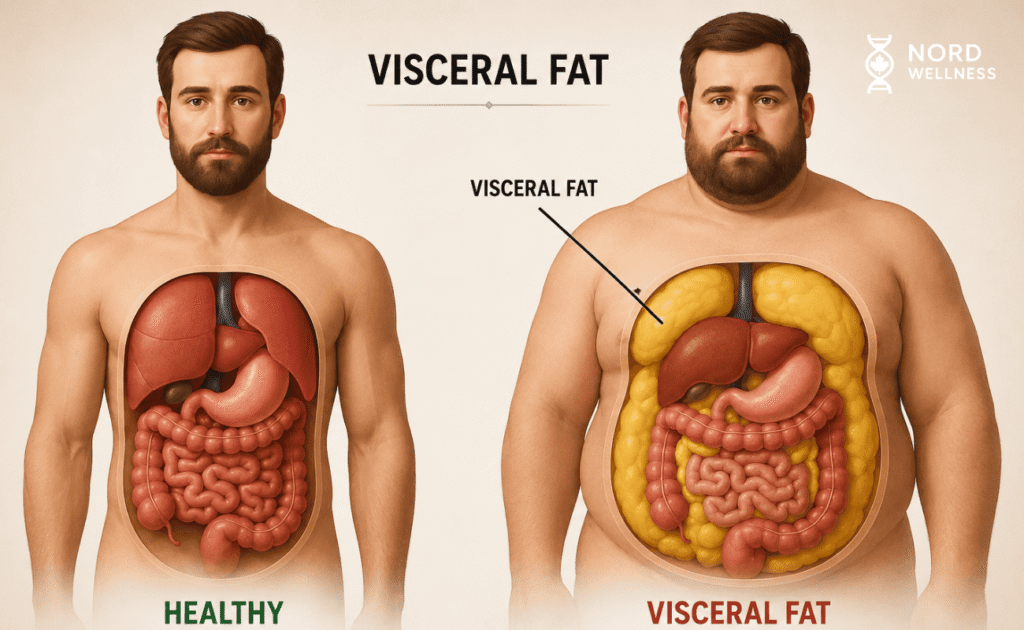
Researchers define visceral fat, also called visceral adipose tissue (VAT), as fat stored around internal organs in the abdominal cavity. They distinguish it from subcutaneous fat, which the body stores directly under the skin.
This distinction matters because visceral fat is metabolically active. It is often studied in relation to insulin sensitivity, lipid metabolism, inflammation markers, cardiovascular risk factors, and endocrine signaling.
| Fat Type | Location | Research Relevance |
|---|---|---|
| Subcutaneous fat | Beneath the skin | Often linked to general body composition and appearance |
| Visceral fat | Around internal organs | More closely linked to metabolic and endocrine research |
| Ectopic fat | In organs such as the liver or muscle | Studied in relation to metabolic dysfunction |
Researchers consider visceral fat difficult to reduce because multiple factors influence it, including hormones, energy balance, lipid metabolism, insulin signaling, inflammation, sleep, age, and overall metabolic health.
This is why researchers often study visceral fat through a pathway-based lens rather than treating it as simple “belly fat.” A compound may be relevant to visceral fat research if it interacts with endocrine or metabolic systems connected to fat distribution and energy regulation.
👉 Explore Tesamorelin Peptide for research purposes at: Tesamorelin Peptide
How Peptides Are Studied for Visceral Fat Reduction
Peptides are studied for visceral fat reduction because some of them interact with signaling pathways involved in metabolism, hormone regulation, appetite, glucose control, lipid turnover, and body composition.
However, not every peptide affects visceral fat through the same mechanism. Some peptide-related compounds are studied for appetite regulation. Others are studied for insulin and glucose pathways. Some are explored in growth hormone signaling research. Tesamorelin belongs primarily to the growth hormone-releasing hormone category.
In research, a peptide for visceral fat reduction may be evaluated through markers such as:
| Research Marker | Why It Matters |
|---|---|
| Visceral adipose tissue volume | Measures deep abdominal fat changes |
| Waist circumference | Common external body composition marker |
| Lipid profile | Helps assess metabolic pathway changes |
| Glucose and insulin markers | Relevant to metabolic regulation |
| Growth hormone activity | Important for GH-related peptides |
| IGF-1 levels | Downstream marker of GH signaling |
| Body composition imaging | CT or MRI may be used in clinical research settings |
Tesamorelin has a particularly well-defined research history because researchers have studied it in relation to excess visceral adipose tissue in adults with HIV-associated lipodystrophy. Health Canada’s Summary Basis of Decision states that regulators considered Egrifta’s benefit-risk profile favourable for treating excess visceral adipose tissue in treatment-experienced adult HIV-infected patients with lipodystrophy under specific measurement criteria.
This makes Tesamorelin highly relevant to visceral fat research, but it does not mean it should be described as a general fat-loss peptide.
Why Tesamorelin Stands Out in Visceral Fat Research
Tesamorelin stands out because it has been studied specifically in relation to visceral abdominal fat, rather than only general body weight.
FDA prescribing information for EGRIFTA WR states that clinicians indicate it for reducing excess abdominal fat in HIV-infected adult patients with lipodystrophy. The same labeling also states that the FDA does not indicate it for weight loss management because it has a weight-neutral effect.
This distinction is essential for accurate peptide education.
Tesamorelin is not best understood as a simple weight-loss compound. Instead, it is better described as a peptide studied for:
- Visceral adipose tissue research
- Growth hormone-releasing hormone signaling
- GH/IGF-1 pathway activity
- Body composition-related mechanisms
- Metabolic regulation research
- Defined clinical study populations
A peer-reviewed study described Tesamorelin as a growth hormone-releasing hormone analog that decreases visceral adipose tissue in people living with HIV, highlighting its relevance in this specific research context.
Tesamorelin and Growth Hormone Pathway Support
Tesamorelin works through the growth hormone-releasing hormone pathway. This is what makes it different from direct growth hormone or appetite-focused compounds.
The mechanism can be summarized as:
| Step | Biological Process |
|---|---|
| 1 | Tesamorelin binds to GHRH receptors in the pituitary gland |
| 2 | Pituitary somatotroph cells are stimulated |
| 3 | Endogenous growth hormone release increases |
| 4 | Growth hormone acts on downstream tissues |
| 5 | IGF-1 signaling may increase |
| 6 | Researchers can study metabolic and body composition-related effects |
Tesamorelin is a synthetic analog of human growth hormone-releasing factor. FDA prescribing information describes its structure as based on the 44-amino-acid human GRF sequence, with a hexenoyl group attached to the N-terminal tyrosine residue.
This pathway matters because growth hormone can influence lipid metabolism, protein turnover, energy balance, and IGF-1 activity. In visceral fat research, these downstream effects are studied to better understand how GH signaling may affect abdominal fat distribution and metabolic markers.
However, it is important to avoid overstating the mechanism. Tesamorelin does not “melt fat.” It stimulates an upstream hormone pathway that may influence metabolic and body composition outcomes in specific research contexts.
👉 Explore Tesamorelin Peptide for research purposes at: Tesamorelin Peptide
Tesamorelin vs Other Peptides for Fat Loss Research
Tesamorelin is often compared with other peptides used in fat loss or body composition research, but these compounds can differ significantly in mechanism.
| Category | Primary Research Pathway | How It Differs from Tesamorelin |
|---|---|---|
| GHRH analogs | GHRH receptor and GH release | Tesamorelin belongs to this group |
| GH secretagogues | Often ghrelin receptor-related | Different receptor pathway |
| GLP-1-related compounds | Appetite, glucose, and insulin signaling | Not a GHRH analog |
| Recovery peptides | Tissue repair and inflammation models | Not primarily visceral fat-focused |
| Direct growth hormone | GH receptor activity | Supplies GH directly instead of stimulating release |
Researchers consider Tesamorelin unique because its best-known research relevance is tied to visceral adipose tissue and growth hormone-releasing hormone signaling. Many other peptides discussed for fat loss do not share the same specific clinical research history related to visceral adipose tissue (VAT).
A clinical review from NCBI states that clinicians indicate Tesamorelin for excess visceral adipose tissue in treatment-experienced adult HIV-infected patients with lipodystrophy, confirmed through waist circumference and CT-based VAT measurements.
For this reason, researchers may more accurately describe Tesamorelin as a visceral fat research peptide rather than simply another general fat-loss peptide.
Safety, Quality, and Research-Use Considerations
Because Tesamorelin interacts with the growth hormone and IGF-1 axis, safety and quality considerations are especially important.
FDA labeling highlights several important limitations and warnings, including that researchers have not established the long-term cardiovascular safety of Tesamorelin and that the FDA does not indicate it for weight loss management.
In research contexts, important considerations include:
- Avoiding general weight-loss claims
- Distinguishing visceral fat research from cosmetic fat loss
- Reviewing GH and IGF-1 pathway effects carefully
- Considering glucose and insulin-related research markers
- Reviewing batch-specific product documentation
- Confirming peptide identity and purity
- Following supplier storage and handling instructions
- Using only in controlled laboratory or educational research contexts
Quality standards matter because peptide research depends on reproducibility. A reliable research-grade peptide should ideally include:
| Quality Factor | Why It Matters |
|---|---|
| Certificate of Analysis | Provides batch-specific testing information |
| HPLC purity data | Helps assess peptide purity |
| Mass spectrometry confirmation | Supports molecular identity verification |
| Lot number | Allows traceability |
| Storage instructions | Helps maintain stability |
| Research-use labeling | Clarifies non-clinical intent |
Researchers should also avoid extrapolating findings too broadly. Researchers have linked Tesamorelin’s strongest clinical evidence to a specific population: adults with HIV-associated lipodystrophy and excess visceral adipose tissue. They should not automatically generalize these findings to all weight-loss or body composition goals.
For deeper research insights, read the full Tesamorelin guide from NordWellness: Tesamorelin Peptide: Mechanism, Benefits, and Growth Hormone Research Insights
FAQ – Peptide For Visceral Fat Reduction
What is a peptide for visceral fat reduction?
A peptide for visceral fat reduction is generally a research compound studied for pathways related to deep abdominal fat, metabolic regulation, lipid metabolism, hormone signaling, or body composition. Tesamorelin is often discussed in this category because of its clinical research history involving visceral adipose tissue.
Why is Tesamorelin discussed for visceral fat research?
Tesamorelin is discussed because it acts as a growth hormone-releasing hormone analog. It stimulates endogenous growth hormone release, which can influence IGF-1 signaling and metabolic pathways connected to visceral adipose tissue research.
Is Tesamorelin approved for weight loss?
No. FDA labeling states that EGRIFTA WR does not indicate the drug for weight loss management because it has a weight-neutral effect. Instead, the FDA indicates it for reducing excess abdominal fat in HIV-infected adults with lipodystrophy.
What type of fat is Tesamorelin most associated with in research?
Tesamorelin is most associated with visceral adipose tissue research. Researchers define visceral fat as deep abdominal fat stored around internal organs, distinguishing it from subcutaneous fat stored under the skin.
How does Tesamorelin work?
Tesamorelin works by binding to GHRH receptors in the pituitary gland. This stimulates endogenous growth hormone release, which may increase downstream IGF-1 signaling and affect metabolic research pathways.
Is Tesamorelin the same as HGH?
No. Tesamorelin is not HGH. HGH is growth hormone itself. Tesamorelin is a GHRH analog that stimulates the body’s own growth hormone release pathway.
How is Tesamorelin different from GLP-1 compounds?
Tesamorelin works through the GHRH receptor and growth hormone pathway. GLP-1-related compounds are typically studied through appetite, glucose, insulin, and incretin-related pathways. They are different categories with different mechanisms.
Can Tesamorelin research apply to everyone with belly fat?
No. Researchers have found the strongest evidence for Tesamorelin in specific clinical populations, particularly adults with HIV-associated lipodystrophy and excess visceral adipose tissue. They should not generalize these findings to everyone seeking fat loss.
Is Tesamorelin for research use only?
Manufacturers typically intend research peptide products for laboratory and educational research purposes only. They do not intend these products for human consumption, diagnosis, treatment, cure, or disease prevention.
Final Thoughts
Researchers often highlight Tesamorelin for visceral fat reduction because it is associated with visceral adipose tissue research, growth hormone-releasing hormone signaling, and metabolic pathway studies. By stimulating endogenous growth hormone release, Tesamorelin may influence downstream IGF-1 activity and body composition-related mechanisms in controlled research settings.
However, it is important to keep the discussion scientifically accurate. Researchers should not present Tesamorelin as a general weight-loss peptide or a guaranteed solution for belly fat. Instead, they primarily associate it with visceral adipose tissue research in specific clinical contexts and with GH/IGF-1 pathway studies in endocrine research.
Disclaimer
This content is provided by Nord Wellness for educational and research purposes only. Tesamorelin Peptide is not approved for the diagnosis, treatment, cure, or prevention of any disease.



Really interesting article explaining why Tesamorelin is getting attention in visceral fat and metabolic research. I liked that the post focused on hormone signaling and long-term metabolic function instead of unrealistic “quick fix” claims. The connection between endocrine health and stubborn visceral fat was especially informative.
Good breakdown of how Tesamorelin may influence visceral fat reduction through hormone-related pathways. A lot of online fat loss content oversimplifies metabolism, so it was refreshing to read something more research-focused and balanced. Curious if future studies will better explain individual metabolic response differences.
I appreciate how the article approaches visceral fat research from a broader wellness and endocrine perspective instead of promoting instant results. The discussion about hormone regulation, metabolism, and recovery made the topic feel much more credible and educational. It definitely seems like science-based wellness discussions are becoming more popular in Canada lately.