

Peptides
The Lab Behind the Iron Curtain That Changed Brain Science
Summarize the article with:
 ChatGPT
 Claude
 Perplexity
 Google AI
Mar
It’s the 1980s. The Cold War is at its height. While the United States and Soviet Union compete in space, nuclear arms, and Olympic sports, a quieter race is happening in laboratories — one that ultimately changed brain science in ways few people noticed.
Soviet neuropharmacologists, working at the Institute of Molecular Genetics of the Russian Academy of Sciences, are reverse-engineering the brain. Not the whole brain — that’s too ambitious even for Soviet ambition. They’re studying a specific problem: how does the brain regulate its own chemistry under stress? And more importantly — can a synthetic molecule teach it to do that job better?
The result of that work wasn’t a weapon. It was two small peptides — Selank and Semax — that would later changed brain science by redefining how the brain adapts to stress.
What Makes These Two Peptides Different From Everything Else
Before diving into the science, it helps to understand why Selank and Semax attract so much interest — especially in an era overflowing with brain supplements, nootropics, and cognitive enhancement claims.
Most products that promise calm or focus work by pushing your brain chemistry in one direction. Stimulants flood your system with dopamine and noradrenaline. Benzodiazepines — the most common class of anti-anxiety drugs — suppress activity across the central nervous system like a dimmer switch. They work, but they work bluntly. Memory impairment, sedation, dependence, withdrawal — these are features, not bugs, of how the mechanism operates.
Selank and Semax don’t work like that. They work more like a conversation with your brain’s existing systems than a command.
Selank: The Anxiety Molecule That Doesn’t Sedate You
Selank is a synthetic heptapeptide — seven amino acids — derived from tuftsin, a naturally occurring fragment of human immunoglobulin G, the backbone of immune memory. Nord Wellness Its creators at the Institute of Molecular Genetics added three additional amino acids at one end specifically to make it more metabolically stable, so it could survive long enough in the body to do its work.
What it does next is where the story gets interesting.
Selank appears to act as a positive allosteric modulator of GABA-A receptors — meaning rather than activating those receptors directly, it changes their shape slightly, making them more responsive to the brain’s own natural calming signal, GABA. Think of GABA receptors as locks. Most anti-anxiety drugs are master keys — they force the lock open regardless of context. Selank is more like a locksmith who files the key to fit better. The lock still only opens when the right key arrives. The difference sounds subtle. Pharmacologically, it’s enormous.
The result? Clinical studies have shown that Selank’s anxiolytic effect is comparable to low-dose benzodiazepine tranquilizers — but without their characteristic side effects. Nord Wellness No sedation. No cognitive blunting. No withdrawal syndrome when you stop. In a clinical trial of 62 patients with generalized anxiety disorder and neurasthenia, Selank showed similar anxiolytic effects to medazepam — but with additional antiasthenic and psychostimulant effects the benzodiazepine didn’t produce.
In plain terms: patients felt less anxious and more mentally energized. Simultaneously. That combination is essentially impossible with traditional anti-anxiety medications.
NordWellness supplies research-grade Selank with third-party purity verification and full COA documentation — view our peptide catalogue here
Semax: When Your Brain’s Own Growth Factor Gets a Signal Boost
Where Selank is primarily an anxiety story, Semax is primarily a focus and resilience story — though the two overlap more than most people realize.
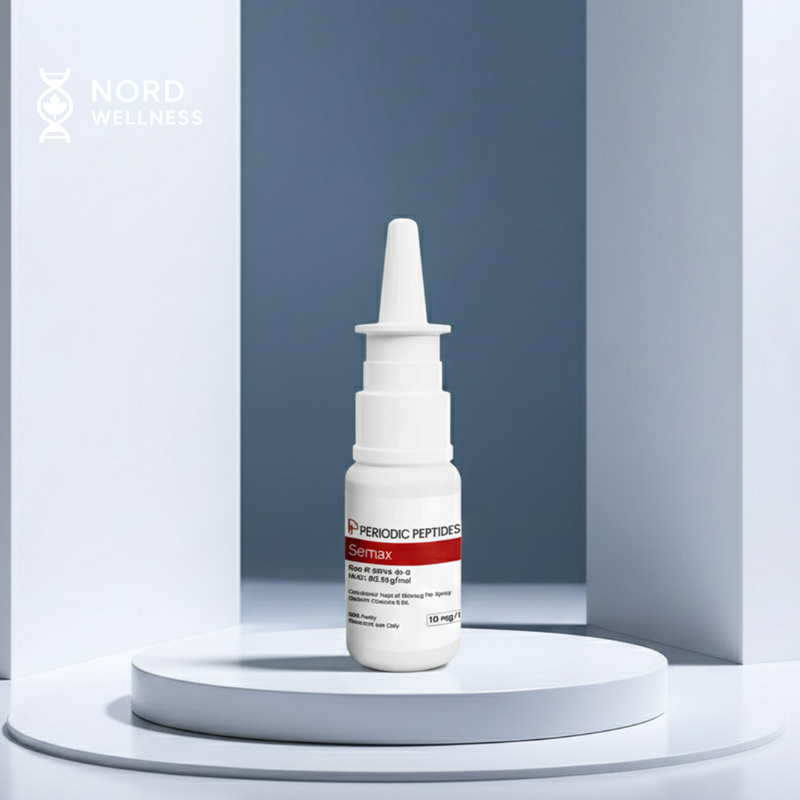
Semax is a synthetic peptide based on a fragment of adrenocorticotropic hormone (ACTH). Research shows it increases brain-derived neurotrophic factor (BDNF), a protein that supports neuron growth, memory, and mental clarity in research models.
BDNF is sometimes called “Miracle-Gro for the brain” — a casual metaphor that’s actually not far from the truth. It’s the primary signal your brain uses to form new neural connections, maintain existing ones, and recover from damage. Low BDNF is consistently associated with depression, cognitive decline, and poor stress recovery. Exercise, sleep, and meditation all raise BDNF. So does Semax — through a distinct molecular pathway.
In animal studies, Semax improved memory, attention, and learning behavior compared with controls. In human fMRI research, the picture gets even more interesting.
A study using resting-state fMRI in 52 healthy participants found that both Selank and Semax produced measurable changes in functional connectivity between the amygdala — the brain’s threat-detection center — and regions of the temporal cortex involved in emotional memory and social processing. These changes appeared within 5 to 20 minutes of administration. That speed is consistent with direct modulation of active brain signaling rather than a slow build-up of compound — and it’s one reason researchers find nasal spray delivery formats so compelling for these peptides.
The “Focus Without Anxiety” Problem — And Why These Two Peptides Together Make Sense
Here’s a challenge that anyone who has tried to perform under pressure will recognize: the very mental states that demand sharp focus — deadlines, high-stakes decisions, creative problem-solving — are exactly the states most likely to trigger anxiety. And anxiety, by definition, degrades the cognitive performance you need most.
Most pharmaceutical interventions force you to choose. Stimulants sharpen focus but often amplify anxiety. Anxiolytics reduce anxiety but blunt the focus you need. It’s a biological trade-off baked into how most of these compounds work.
Selank offers a unique dual-action profile — addressing both anxiety and cognitive function through distinct molecular pathways. Semax, with its BDNF-driven focus enhancement, covers the cognitive dimension more directly. Together, Semax suits studies investigating attention mechanisms and stress resilience, while Selank appears most frequently in anxiety and stress-related research — making their combination particularly relevant for studying performance under psychological stress.
This complementary pairing is why researchers increasingly study them together rather than in isolation — and why NordWellness offers both as part of our cognitive research peptide range.
What “Research-Grade” Actually Means for Brain Peptides
This is worth pausing on, because for brain-active compounds especially, purity isn’t just a quality metric — it’s a safety and validity concern.
Selank and Semax are both relatively small peptides, but their mechanisms depend on precise molecular geometry. A degraded or incorrectly synthesized batch doesn’t just fail to work — it may interact with receptor sites in unpredictable ways, producing data artifacts or, in human use contexts, unintended neurological effects.
At NordWellness, every batch of Selank and Semax undergoes independent third-party HPLC and mass spectrometry testing, with Certificates of Analysis available directly on each product page. For institutional researchers requiring documentation for ethics submissions or procurement, our team is available to assist — contact us here.

The Bigger Picture: What These Peptides Reveal About Anxiety Itself
The story of Selank and Semax isn’t just about two compounds that happen to work well on the brain. It points toward a broader reframing of what anxiety actually is.
For decades, Western psychiatry treated anxiety primarily as a chemical deficiency — too little GABA, too much cortisol — to be corrected by adding or blocking specific molecules. Selank’s ability to alter the expression of genes involved in dopaminergic and GABAergic neurotransmission simultaneously suggests a more complex picture: that anxiety may involve patterns of gene expression and receptor sensitivity, not just neurotransmitter levels.
That’s a meaningful shift. It suggests that the most effective interventions might not be the ones that override brain chemistry, but the ones that help the brain recalibrate itself. Selank, with its allosteric mechanism and gene-level effects, is one of the most compelling early examples of what that kind of recalibration might look like.
Soviet scientists figured that out forty years ago. The rest of the world is still catching up.
👉 Shop Selank & Semax at NordWellness Canada
👉 Explore our full cognitive peptide range
👉 Read our Thymosin Alpha-1 immune peptide guide
👉 Contact us for institutional or bulk orders
Disclaimer
This content is provided by Nord Wellness for educational and research purposes only. Melanotan II is not approved for the diagnosis, treatment, cure, or prevention of any disease.



Great article—really fascinating how Cold War research led to discoveries like Selank and Semax. It shows that instead of forcing brain chemistry, these peptides seem to work by modulating the brain’s own stress-response systems.
I like how the article explains the difference between traditional drugs and these peptides. Instead of acting like a ‘switch,’ they seem to fine-tune existing pathways, which makes their mechanism much more nuanced.
Very informative read. What stands out is how quickly these peptides can influence brain connectivity, especially between areas related to stress and emotion, which highlights their potential role in cognitive research.